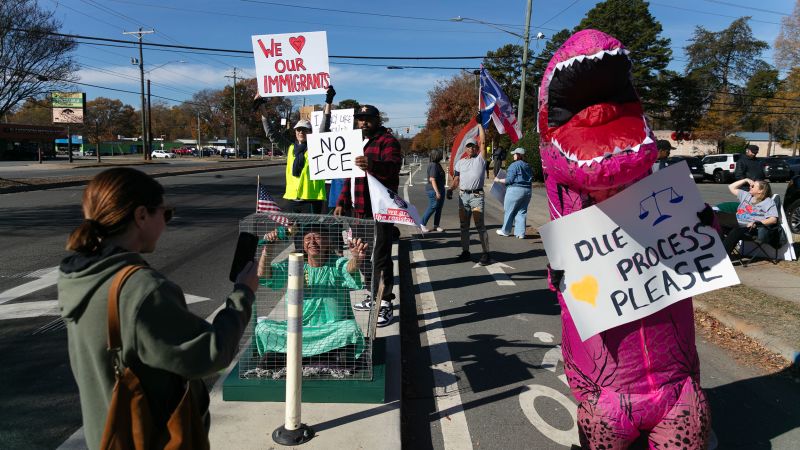
Federal immigration raids dubbed Operation Charlotte’s Web, part of a DHS surge led by Border Patrol Chief Gregory Bovino that has hit several major cities this year, resulted in more than 250 arrests in the Charlotte area over four days and have provoked protests, fear and shut‑ins in immigrant‑dense Plaza Midwood; schools reported roughly 30,000 absences (about 20% of district enrollment) on Monday. The enforcement action has forced dozens of minority‑owned small businesses to close or operate with reduced staff and customers—community group CharlotteEAST estimates losses of roughly $400/day for a small tienda, $500/day for a hair salon and $5,000/day for a restaurant—while merchants scramble to offer delivery and patrons rally financial support. For investors and local economists, the episode signals a concentrated near‑term shock to neighborhood consumer spending and labor availability in immigrant‑dependent sectors, as well as heightened political and operational risk for businesses in other cities targeted by similar DHS enforcement campaigns.
Federal immigration raids branded Operation Charlotte’s Web, led by Border Patrol Chief Gregory Bovino, produced more than 250 arrests in the Charlotte area over four days, according to the Department of Homeland Security; DHS released a list of alleged criminal records for those arrested and said it is “surging” enforcement to remove public-safety threats. Bovino’s team has staged weeklong operations in Los Angeles and Chicago this year and New Orleans was flagged as a next stop, establishing a pattern of concentrated enforcement in large, Democratic-led cities noted in the article.
The enforcement action has materially suppressed local consumer activity in Plaza Midwood: dozens of minority-owned small businesses closed or operated with reduced staff and customers, Manolo’s Bakery shut temporarily, and Charlotte-Mecklenburg Schools reported roughly 30,000 absences (about 20% of enrollment) on a Monday. Community group CharlotteEAST estimates operating losses of about $400/day for a small tienda, $500/day for a hair salon and $5,000/day for a restaurant, while merchants pivot to free delivery and donations to mitigate lost sales.
Near term, the episode represents a localized shock to consumer spending and labor availability in immigrant-dependent sectors and raises operational and reputational monitoring points for larger footprint owners and retailers; the article cites a Border Patrol pickup at a Lowe’s and DHS did not respond to questions about that incident. Continued enforcement rounds and attendant protests create measurable political and operational risk that could replicate in other targeted cities and depress street-level commerce until community confidence and school/work attendance recover.
AI-powered research, real-time alerts, and portfolio analytics for institutional investors.
Request DemoOverall Sentiment
moderately negative
Sentiment Score
-0.45
Ticker Sentiment
