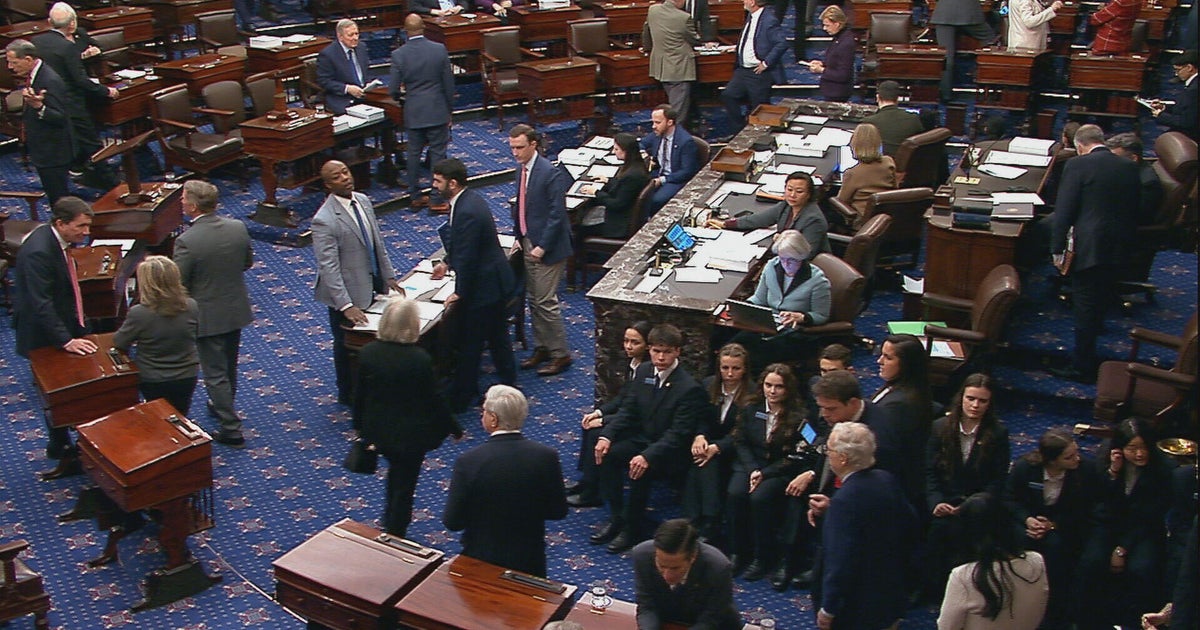
The Senate passed a bipartisan five-bill spending package late Friday in a 71-29 vote but funding is still set to lapse at midnight because the House must approve the measure, likely when it returns Monday. The deal includes a two-week extension of Department of Homeland Security funding while lawmakers negotiate immigration enforcement reforms; several floor amendments (including proposals from Sanders and Merkley) were rejected or tabled, and Sen. Lindsey Graham lifted his hold after securing commitments for future votes on sanctuary-city and litigation measures. Markets should view the outcome as reducing the risk of a prolonged shutdown, but near-term uncertainty remains until the House acts and the president signs the package.
Market structure: The Senate passage but overnight lapse leaves probability of a prolonged shutdown low but front-loaded political risk high over the next 72 hours (House returns Monday). Short-term winners are large defense primes and federal IT/cyber vendors (stable appropriations flow); losers are vendors dependent on DHS/ICE discretionary changes and private detention operators. Market pricing should see micro-volatility in small-caps and cyclical names sensitive to federal contract timing while large-cap defensives see modest bid.
Risk assessment: Tail risks include a House rejection or hardline amendments that extend negotiations into a multi-week shutdown (5–10% downside shock to small-caps, 10–25bp move in front-end yields). Immediate (days): headline-driven ID volatility; short-term (weeks): cash-flow timing disruptions to contractors, hospitals, universities; long-term (quarters): potential policy shifts on ICE funding that reallocate ~$billions across agencies. Hidden dependency: CMS/Medicaid cash flows and grant reimbursements can cascade to healthcare services and muni revenue timing within 2–6 weeks.
Trade implications: Favor modest long exposure to defense primes (LMT, RTX, GD) and large-cap cyber (PANW, FTNT) with 3–12 month horizons while hedging headline risk with 30–60 day TLT calls or buy-protective puts on small-cap ETF (IWM). Short private prison operators (GEO, CXW) and any pure-play DHS services contractors with >30% revenue tied to ICE on 3–6 month view. Use pair trades to capture relative safety: long LMT vs short IWM during headline windows.
Contrarian angles: Consensus downplays the two-week DHS carveout — that creates a concentrated policy negotiation window where ICE funding could be altered materially, creating asymmetric downside for detention contractors but upside for Medicaid-exposed healthcare providers if reallocation occurs. Market may underprice the idiosyncratic political blocking risk (Graham/House) so temporary options hedges are cheap; a failed House vote would create a buying opportunity in cyclicals within 5–10% dislocation based on past partial-shutdown episodes.
AI-powered research, real-time alerts, and portfolio analytics for institutional investors.
Request DemoOverall Sentiment
neutral
Sentiment Score
0.10
