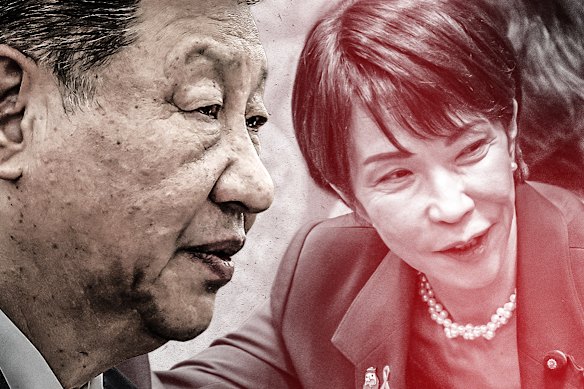
Beijing has mounted a month-long campaign of political, economic and military coercion against Japan after Prime Minister Sanae Takaichi said a Chinese move on Taiwan could create a “survival‑threatening” situation for Japan, deploying measures that include travel warnings and cancellations of some 2,000 flights, bans on Japanese seafood and cultural imports, stepped-up patrols and joint drills with Russia. Tensions escalated with reports that Chinese jets locked radar on Japanese aircraft, prompting belated public comments from the US and joint flights by US strategic bombers with Japanese fighters and expressions of concern from Australia, highlighting limits to Western willingness to intervene. The campaign has amplified domestic nationalism in China, boosted Takaichi’s approval (polls showed about 64% in November) and materially strengthens the political case in Tokyo for revising its pacifist posture and increasing defence spending, while underscoring Beijing’s readiness to use economic coercion and military signalling to police Taiwan-related discourse.
China has mounted a month‑long campaign of political, economic and military coercion against Japan after Prime Minister Sanae Takaichi stated a Chinese move on Taiwan could create a "survival‑threatening" situation for Japan. Measures cited include travel warnings and cancellations of some 2,000 flights, bans on Japanese seafood and cultural imports, cancelled concerts and stepped‑up military patrols, while Beijing has denied Tokyo’s account of radar‑locking incidents.
The US and Australia offered limited public support only after the radar episode: US strategic bombers flew with Japanese fighters and the State Department called the encounter "not conducive to regional peace and stability," while Australia expressed concern but avoided criticizing Beijing’s economic pressure. China’s joint drills with Russia and repeated diplomatic/media attacks underline a calibrated coercive strategy that stops short of direct military confrontation but raises regional risk.
Politically, the campaign has strengthened Takaichi domestically—her approval rose to about 64% in November—thereby enhancing the political case in Tokyo for revisiting postwar security constraints and potentially increasing defence spending. For Beijing, the measures also serve to mobilize nationalism amid a weak domestic economy and to police Taiwan‑related discourse.
Market signals provided show a moderately negative sentiment score of -0.45 and a market impact score of 0.5, indicating a risk‑off response with sectoral pressure likely in travel & leisure, media/entertainment, and Japan‑China trade‑exposed exporters. Investors should expect near‑term disruption to tourism and cultural revenues, elevated geopolitical tail‑risk, and the possibility of policy‑driven reallocation if Tokyo pursues sustained defence expansion.
AI-powered research, real-time alerts, and portfolio analytics for institutional investors.
Request DemoOverall Sentiment
moderately negative
Sentiment Score
-0.45
