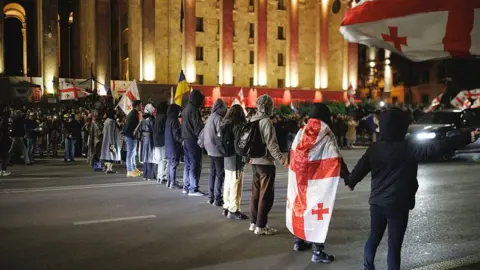
Sustained nightly protests in Tbilisi mark a year of resistance after Prime Minister Irakli Kobakhidze halted Georgia's EU accession moves on 28 November 2024, while the ruling Georgian Dream — which won 54% in last year's disputed elections — has pushed through repressive laws (including fines, criminal penalties for blocking roads and a foreign grants approval regime) and jailed opposition figures facing up to 15 years. The EU now considers Georgia a candidate 'in name only', raising political and regulatory risk for investors as the government pivots rhetorically toward pragmatic ties with Russia and deepens strategic and investment links with China. For investors, the story increases sovereign and country-risk premia, heightens regulatory and legal uncertainty for NGOs, media and universities, and suggests potential reputational and operational risks for exposure to Georgian assets.
Market structure: The immediate winners are state-aligned infrastructure contractors (Chinese-backed builders) and political incumbents who can reallocate foreign-grant budgets; direct losers are Georgian sovereign and domestic-bank creditors, NGOs, independent media and university economics that depend on Western funding. Capital inflows are likely to slow materially: expect Georgian USD sovereign spreads to widen ~100–300bp and GEL to weaken 5–15% over 6–12 months, pressuring local credit and equity valuations relative to EM peers.
Risk assessment: Tail risks include a sharp escalation (large-scale unrest, targeted Russian hybrid pressure or a ratings downgrade) that could trigger a sudden stop in foreign financing — a low-probability, high-impact event that would push sovereign spreads >400bp and spark bank funding stress. Time horizons: days–weeks for protests and arrests (market volatility spike), 1–6 months for policy/legal shocks to affect flows, and 6–24 months for structural reorientation (EU candidacy effectively suspended) to crystallize credit outcomes; hidden dependencies include FX mismatches at Georgian banks and Chinese state-backed loan covenants.
Trade implications: Tactical plays should hedge sovereign and FX risk and buy macro insurance: trim Georgian sovereign/bank exposure, short GEL vs USD (forwards) and buy protection via 3–5y sovereign CDS; rotate into liquid safe-havens (GLD, TLT) and EM downside hedges (EEM puts). Options strategies (3-month put spreads on EEM and puts on Georgian bank tickers where liquid) provide cheap convexity if headlines worsen; use size 1–3% portfolio per trade and scale on specified triggers.
Contrarian angles: The market may overshoot: if the government seeks IMF/Western financial lifelines or Beijing provides large, unconditional financing, spreads can retrace 150–250bp in 3–9 months — creating a mean-reversion buy window. Historical parallels (selective recoveries after EM political shocks) suggest staged entry: concentrate initial shorts and insurance now, but keep dry powder to flip to long on spread overshoot thresholds.
AI-powered research, real-time alerts, and portfolio analytics for institutional investors.
Request DemoOverall Sentiment
strongly negative
Sentiment Score
-0.65
