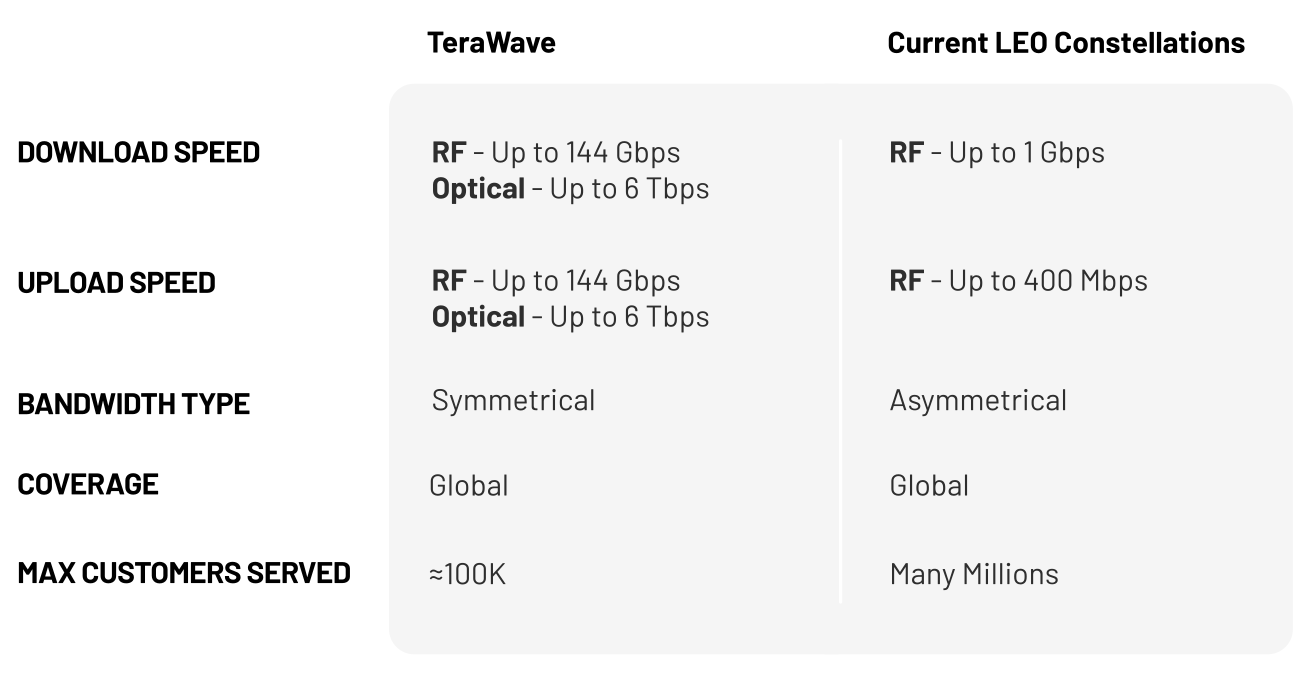
Blue Origin announced TeraWave, a space-based communications network designed to deliver symmetrical data speeds up to 6 Tbps globally using a multi-orbit constellation of 5,408 optically interconnected satellites (5,280 LEO delivering up to 144 Gbps per customer via Q/V-band and 128 MEO providing up to 6 Tbps via optical links). Targeting enterprise, data center and government customers, TeraWave is positioned to complement fiber backhaul, provide route diversity and rapid deployment of enterprise-grade terminals, with constellation deployment slated to begin in Q4 2027.
Market structure: Blue Origin’s TeraWave design (5,408 sats, 6 Tbps capacity, rollout starting Q4 2027) favors large aerospace suppliers, optical component makers, and gateway/data‑center integrators while threatening enterprise fiber incumbents that sell high‑margin last‑mile and hybrid backhaul (e.g., Lumen). Expect winners in satellite manufacturing and launch supply chains (Lockheed LMT, Northrop NOC, RTX) and specialist optical/V‑band gear (Ciena CIEN, NeoPhotonics NPTN) as enterprise customers seek route diversity and symmetrical 144 Gbps–6 Tbps links.
Risk assessment: Key tail risks are (1) financing and execution strain at Blue Origin — ~5,408 sats + 128 MEO sats implies multi‑$bn capex and supply pressure; (2) regulatory/spectrum fights (FCC/ITU, export controls) that could delay service >12–36 months; (3) competitive retaliation from SpaceX/OneWeb driving price compression. Short term (0–12 months) expect supplier contract rumors and modest stock moves; medium term (12–36 months) execution and spectrum clarity will drive repricing.
Trade implications: Tactical longs: 2–4% portfolio exposure to LMT and NOC (manufacturing backlog benefits within 6–18 months); 1–2% long CIEN for optical gear. Tactical shorts: 2–3% short LUMN (enterprise fiber exposure) or buy 9–15 month put spreads targeting a 10–25% downside if enterprise churn materializes. Options: buy 12–18 month call spreads on LMT (e.g., buy ATM, sell +20% strike) to cap cost while capturing backlog upside.
Contrarian angles: Market may underprice execution and financing risk — Blue Origin could delay; incumbents may form consortiums to block spectrum access or strike pricing deals, limiting disruption. Historical parallel: OneWeb’s bankruptcy then strategic reset shows government/partner funding can rescue players but also compress returns. Watch supply‑chain lead times (semiconductor/optical) and FCC filings over next 30–90 days as high‑conviction catalysts.
AI-powered research, real-time alerts, and portfolio analytics for institutional investors.
Request DemoOverall Sentiment
mildly positive
Sentiment Score
0.35
