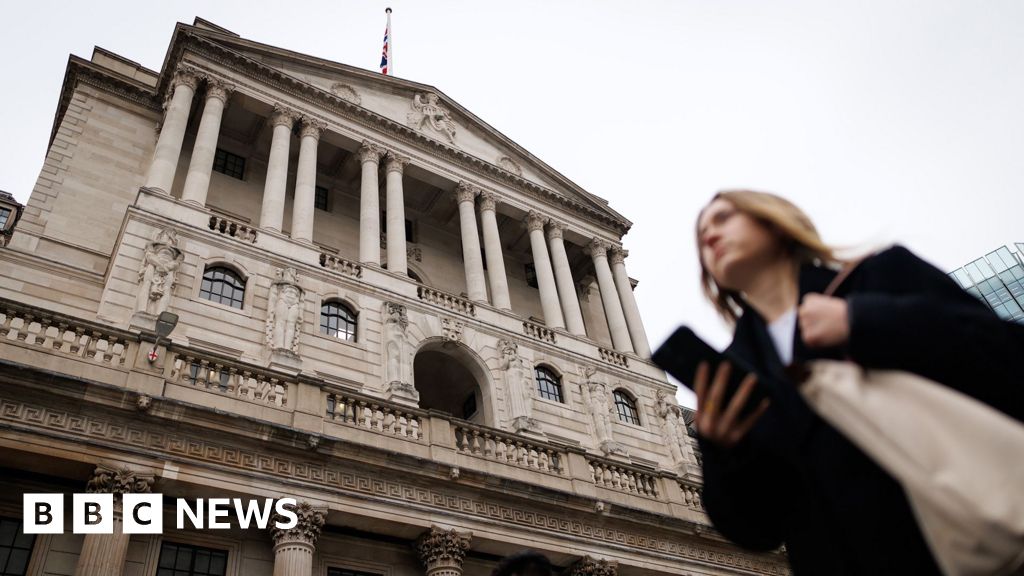
The Bank of England's Monetary Policy Committee is widely expected to keep the Bank rate on hold at 3.75% at its next meeting after cutting it from 4.0% in December; inflation stood at 3.4% year-on-year to December. The MPC voted narrowly for the December cut and has signaled a gradual downward path, but has given cautious guidance and is likely to be vague on the timing and size of future cuts (markets are pricing limited near-term change). The article highlights household exposure — roughly one million tracker/variable mortgages and widespread cuts to savings rates (about 70% of providers have trimmed rates), factors that could temper consumption and influence bank pricing and mortgage market dynamics going forward.
Market structure: A BoE hold at 3.75% (with guidance for gradual cuts) benefits short-dated money market participants and incumbent fixed-rate lenders while keeping pressure on savers and variable-rate mortgage holders. UK banks (LLOY.L, NWG.L, HSBA.L) gain near-term NIM stability versus mortgage-dependent builders/REITs (PSN.L, BDEV.L, GRI.L) that face weaker demand; expect credit spread compression in bank senior debt but continued fragility for consumer unsecured credit. Cross-asset: gilt yields should remain supported at the front end (2s–5s), limiting rallies in long gilts unless clear multi-cut signalling appears; GBP is likely range-bound with downside capped absent dovish surprise, while UK equities will bifurcate (financials outperform cyclicals/real estate).
Risk assessment: Tail risks include a CPI re-acceleration >4% (forces hawkish surprise and 50–100bp re-pricing in short gilts) or a sharp UK recession (triggers 100–200bp of cuts and a gilts rally, credit stress for mid-tier lenders). Immediate risks (days) center on MPC language and market-implied cuts priced into short-end futures; over 3–12 months the path of inflation versus wage growth will determine 1–2 cuts in 2026. Hidden dependencies: mortgage book seasoning, wholesale funding cost trajectory, and BoE liquidity operations can flip outcomes quickly. Catalysts: next CPI prints, wage data, and BoE Monetary Policy Report (this meeting) will accelerate repositioning.
Trade implications: Favor selective long positions in large-cap UK banks and short/underweight UK homebuilders/REITs; implement yield-curve strategies (steepener if market starts pricing cuts aggressively). Use options to express asymmetric views: buy put spreads on long-dated gilts if inflation surprises higher, or call spreads on Lloyds/NatWest into Q2 results. Timing: enter position window 0–7 days after MPC wording clarity; tighten stops if BoE signals 2+ cuts in 2026.
Contrarian angles: Consensus underestimates banking sector resilience if growth stays soft but rates sticky — banks can reprice new lending and widen spreads for 6–12 months, making a 2–4% tactical long in LLOY.L/NWG.L asymmetric. Conversely, if markets have already priced a single 2026 cut, long-dated gilts are vulnerable to a hawkish CPI print (mispricing of duration). Historical parallel: 2019–20 episodes showed BoE verbal caution can keep yields elevated; don’t chase long-gilt rallies until cuts are fully priced (market-implied cut probability >60% for H1 2026).
AI-powered research, real-time alerts, and portfolio analytics for institutional investors.
Request DemoOverall Sentiment
neutral
Sentiment Score
0.00
