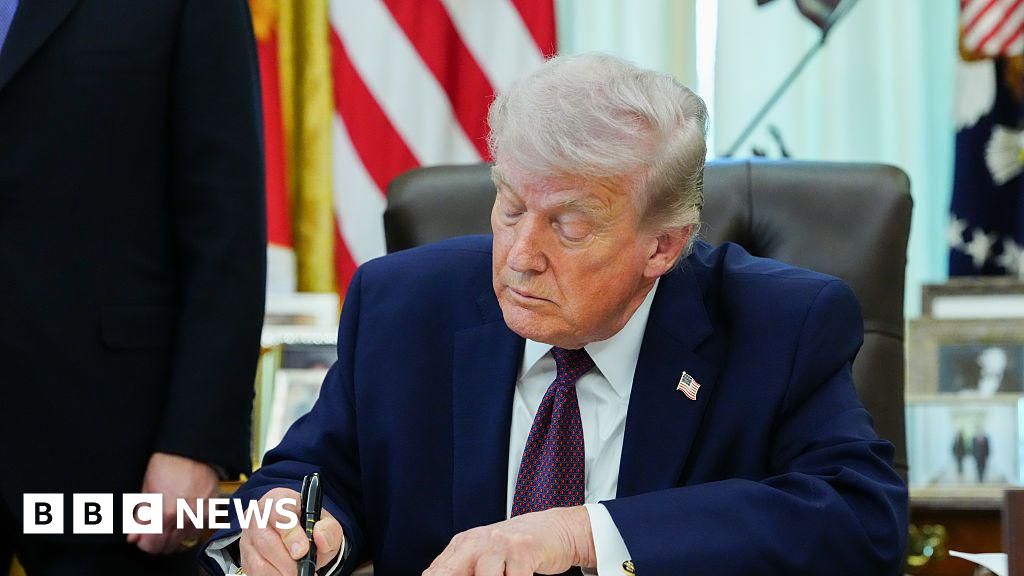
President Trump signed an executive order directing USPS to send ballots only to individuals on state-specific mail-in and absentee participation lists compiled by DHS and the Social Security Administration; Democrats filed suit seeking to block the move. Legal experts say the president lacks authority and similar orders have been blocked by courts, making implementation unlikely before the referenced 2026 midterm elections and creating political/legal uncertainty with minimal near-term market impact.
A realistic policy path here is not a clean binary (implemented vs blocked) but a multi-quarter litigation and regulatory tug-of-war that creates idiosyncratic revenue windows for vendors tied to identity verification and secure-mail processing. If even a subset of states or federal contractors accelerate requirements for verified voter manifests, data-aggregators that already serve government clients could see incremental contract wins worth mid-to-high single-digit percent revenue upside annually; calibrate upside as $50–200M TAM per winner in a partial-adoption scenario.
Operationally, a short-lived administrative push would generate lumpy, high-margin orders for envelope/labeling, barcode/track-and-trace hardware and related software integration — suppliers with spare capacity and short manufacturing lead times (12–20 weeks) capture most uplift, while incumbents with long lead times miss the window. Conversely, private carriers and election-tech incumbents face coordination friction: temporary reroutes, extra handling, and contract renegotiations can compress margins for 1–3 quarters even if final policy does not stick.
Market reaction hinges on two catalysts: (1) near-term court scheduling (injunction risk priced within 4–12 weeks) and (2) any congressional movement to codify verification standards (6–18 months). Positioning should therefore differentiate between a tactical revenue pop for contractors and a structural change that materially expands identity-verification TAM; treat the former as tradeable event risk and the latter as a buy-and-hold thesis contingent on legislative progress.
AI-powered research, real-time alerts, and portfolio analytics for institutional investors.
Request DemoOverall Sentiment
mildly negative
Sentiment Score
-0.15
