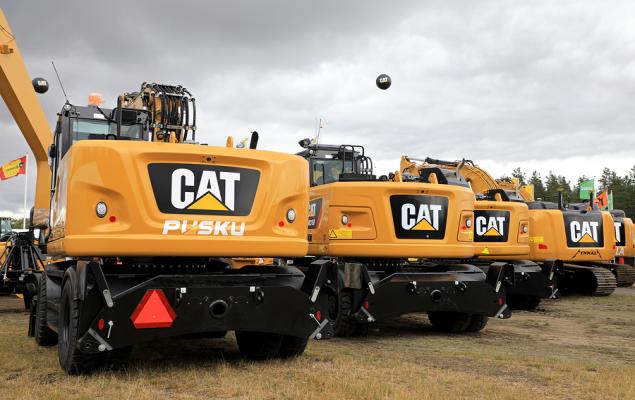
Caterpillar (CAT) and Volvo (VLVLY) face near-term headwinds with declining earnings estimates for 2025, though both are positioned for long-term growth due to infrastructure development. CAT's Q1 2025 earnings fell 24% on weak demand, while Volvo CE's sales slid 8%; however, Volvo's stock has outperformed CAT year-to-date. Despite a higher valuation, CAT's superior return on equity and a Zacks Rank #3 (Hold) suggest it may be a more favorable investment compared to Volvo's Zacks Rank #4 (Sell).
The heavy equipment sector, represented by Caterpillar and Volvo, is currently navigating a period of weak demand and tariff uncertainties, impacting near-term financial performance. Caterpillar reported a significant 24% drop in Q1 2025 earnings, following six consecutive quarters of volume declines and a 9.8% revenue decrease in the same quarter, primarily due to subdued customer spending in its Construction and Resource Industries segments, exacerbated by China's real estate downturn and soft European demand. Caterpillar's revenues also declined 3.4% in fiscal 2024. However, Caterpillar's outlook is supported by its substantial U.S. production base, which offers a competitive advantage; robust demand for reciprocating engines from AI data centers, prompting a planned output doubling with multi-year investment; growth in high-margin aftermarket services; and anticipated benefits from the U.S. Infrastructure Investment and Jobs Act and increasing adoption of its autonomous fleet by miners. Conversely, Volvo Construction Equipment (Volvo CE) experienced an 8% sales slide in Q1 2025, continuing a trend from fiscal 2024 where its net sales fell 16% due to high interest rates and low confidence in Europe, alongside cooling North American demand. Despite this slowdown, Volvo is actively innovating, having launched over 80 new models in 2024—its largest product launch to date—including an expanded electric equipment range and its first electric wheeled excavator. Volvo CE is also making strategic global investments in localized crawler excavator production to meet growing demand and mitigate supply-chain risks, and is advancing autonomous hauling solutions, recently surpassing 1 million tons of limestone hauled autonomously in Norway. Financially, Zacks Consensus Estimates project a 14.6% earnings decline for Caterpillar in 2025 to $18.70 per share, before an anticipated 12.8% rebound in 2026 to $21.09 per share. Volvo's fiscal 2025 earnings are expected to dip 4.3% to $2.24 per share, before a projected 13.7% rise in 2026 to $2.55 per share; EPS estimates for both companies for 2025 and 2026 have trended south over the past 60 days. Year-to-date, Volvo's stock (VLVLY) has appreciated 16.3%, outperforming Caterpillar (CAT), which dipped 0.5%. Caterpillar trades at a forward 12-month earnings multiple of 18.26x, higher than its five-year median and Volvo's 11.8x (which is also above its five-year median); both are at a discount to the sector average of 19.16x. Critically, Caterpillar exhibits a substantially higher return on equity (53.77%) than Volvo (24.36%), indicating more efficient use of shareholder funds. Reflecting these factors, Caterpillar currently holds a Zacks Rank #3 (Hold), while Volvo is rated #4 (Sell), leading to the assessment that Caterpillar might be the more favorable option despite its higher valuation.
AI-powered research, real-time alerts, and portfolio analytics for institutional investors.
Request DemoOverall Sentiment
neutral
Sentiment Score
0.10
Ticker Sentiment
