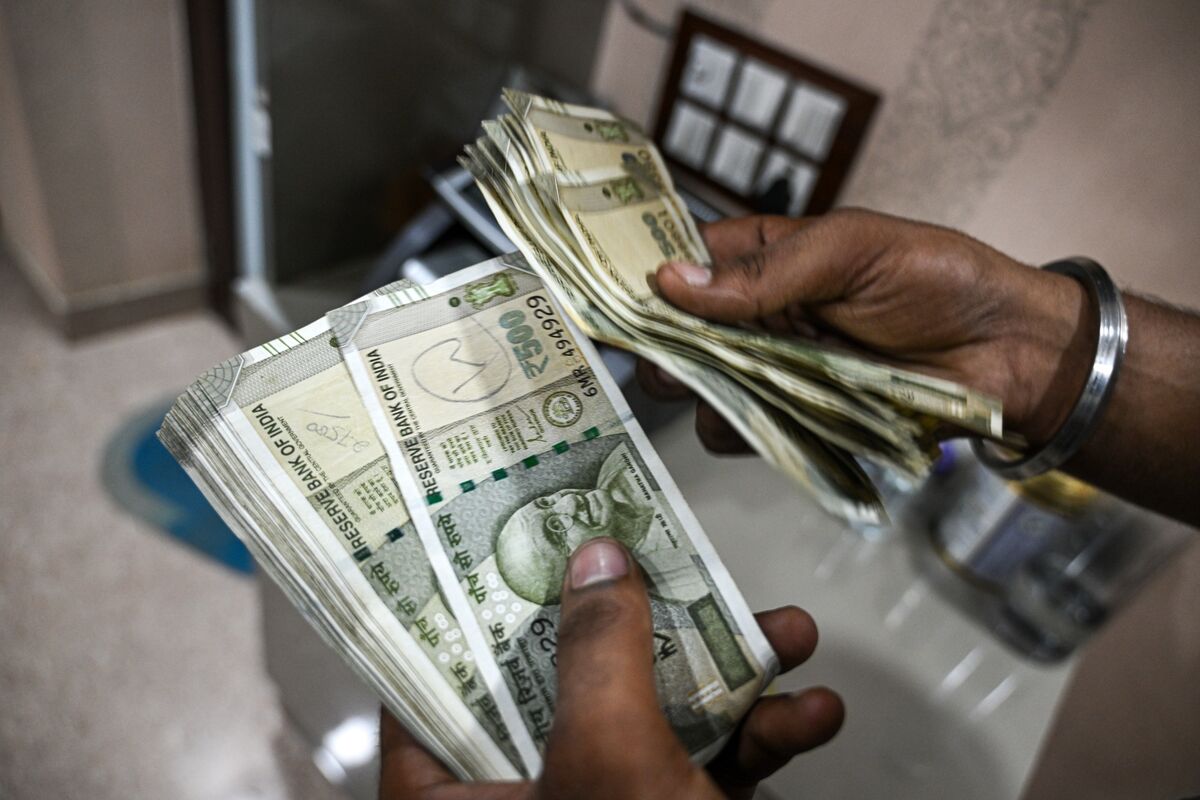
Goldman Sachs' chief India economist forecasts the rupee could weaken to 95 per USD over the next year due to fallout from the Iran conflict. He warns the currency is under pressure as India's current account deficit widens, which could force the RBI to intervene if inflation picks up. This outlook raises downside risk for the rupee and could influence RBI policy and domestic interest-rate expectations.
A weaker INR is a redistribution shock: corporates with material USD debt (typical leverage buckets: 20–50% FX debt for mid-tier developers/NBFCs) see interest and amortisation costs rise roughly in line with the FX move, compressing EBITDA margins by low-to-mid single digits within quarters. Exporters (IT, pharma, select chemicals) gain a margin tailwind that is immediate and partially hedged into their booking cycles, so their reported USD revenue upside is visible within 1–2 quarters. Policy mechanics matter more than the headline FX level. The central bank can blunt disorder via spot sales, FX swaps and targeted liquidity, or by hiking rates — each has different downstream impacts: FX intervention drains reserves and is liquidity-negative; a rate hike broadens spread to local credit and can lift 10y yields by an estimated 25–75bp depending on scale. Market-implied volatility in INR typically gaps up during these regimes, creating a convex payoff for option structures that buy optionality rather than linear forward exposure. Tail risks are concentrated: a renewed global risk-off that tightens dollar liquidity or a sustained commodity shock can force larger outflows and push domestic funding stress into lower-rated credits within months. The mean-reversion catalysts are equally concrete — a return of portfolio flows, a decisive drop in fuel/commodity prices, or an orchestrated swap line/sizable reserves restoral can compress the move within 6–12 weeks. Watch the sequencing of FX reserve change, FX forwards positioning and 1–3m inflation prints as real-time indicators. Consensus tends to treat this as a near-term directional story; that understates the heterogeneity across balance sheets. The real opportunities are in convex hedges and sector pairs rather than blunt long-spot exposure — overstated currency-driven equity sell-offs often leave USD earners cheap and domestically leveraged names vulnerable to policy tightening and funding squeezes.
AI-powered research, real-time alerts, and portfolio analytics for institutional investors.
Overall Sentiment
mildly negative
Sentiment Score
-0.35
Ticker Sentiment
