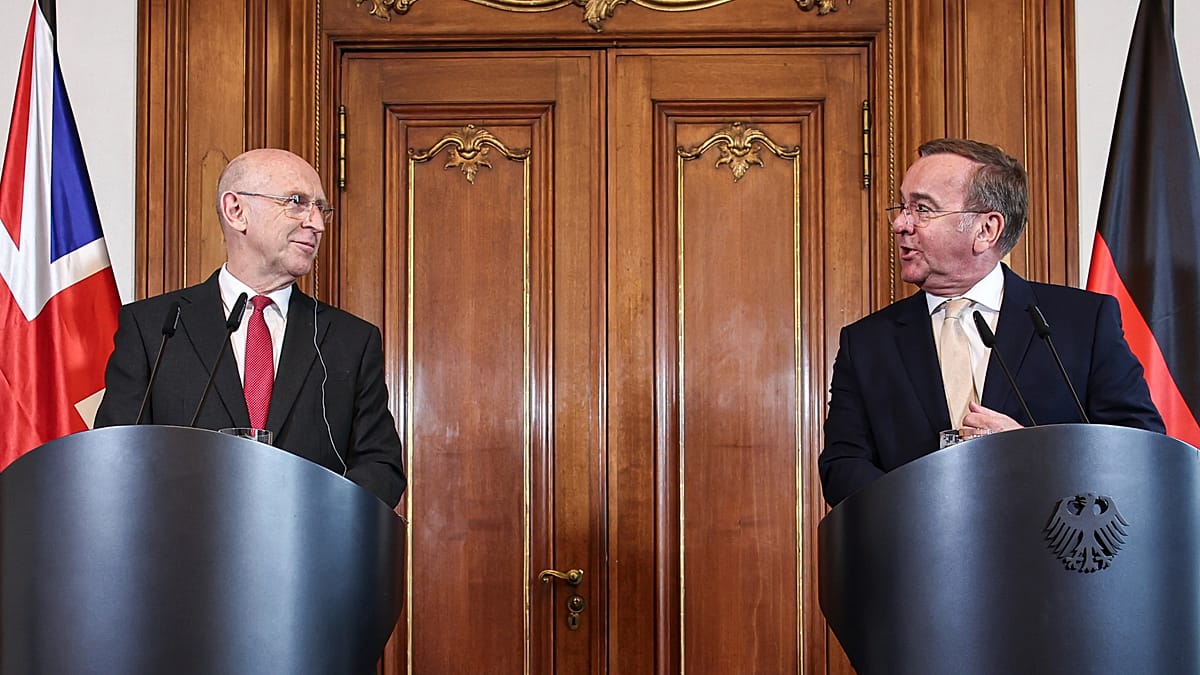
Germany and the UK have signed a joint procurement contract worth $72 million (≈€61 million) to acquire RCH 155 mobile artillery systems—one demonstrator for the British Army and two test units for Germany—manufactured by KNDS with Rheinmetall. The systems can fire on the move, reach targets beyond 70 km, deliver up to eight rounds per minute and the vehicles have a stated 700 km range; the deal is part of a broader bilateral push on long-range precision-strike capability and increased anti-submarine cooperation under the Trinity House framework, a development that modestly benefits defence industrial suppliers and underpins deeper military-industrial ties between the countries.
Market structure: The initial €61m demonstrator contract is small but a credible signal that Berlin/London will preferentially route future artillery, long-range strike and ASW work to European primes (KNDS/Rheinmetall/Hensoldt/Thales/Leonardo). Expect incremental pricing power for Rheinmetall (RHM.DE) and related subsystem suppliers as programs scale — a plausible follow-on market of €0.5–1.5bn across EU/UK over 3 years if cross-government trials succeed. US primes (LMT/RTX) face modest share headwinds on sovereign UK/DE programs, not demand destruction globally.
Risk assessment: Tail risks include German parliamentary funding reversals, export-control frictions and integration failures; each could wipe 30–60% of expected program upside in 12 months. Timing: demonstrators/delivery and trials likely within 6–12 months, procurement scaling decision points in 12–36 months. Hidden dependency: advanced semiconductors and artillery munitions supply chains (chip/propellant) are chokepoints—watch lead times and inventories.
Trade implications: Direct: overweight Rheinmetall (RHM.DE) for 12–24 months (target +20–40%), add BAE Systems (BA.L) for UK industrial capture (target +15–25%). Pair: long RHM.DE (2%) / short ITA ETF (1.5%) to express European outperformance vs US-centric defense. Options: buy 12-month call spreads on RHM.DE to cap cost; size for 1–3% portfolio risk.
Contrarian angles: Consensus understates scaling potential from trilateral modular systems—small demonstrator -> follow-on cluster purchases across NATO is realistic, but also undercounts margin pressure from rising steel/ammo costs and tighter deficits that could compress multiples. Historical parallel: post‑2014 EU rearmament lifted European defense names for 24–36 months, but selection mattered; avoid broad index exposure and focus on companies with vehicle/platform assembly and munitions supply lines.
AI-powered research, real-time alerts, and portfolio analytics for institutional investors.
Request DemoOverall Sentiment
neutral
Sentiment Score
0.15
