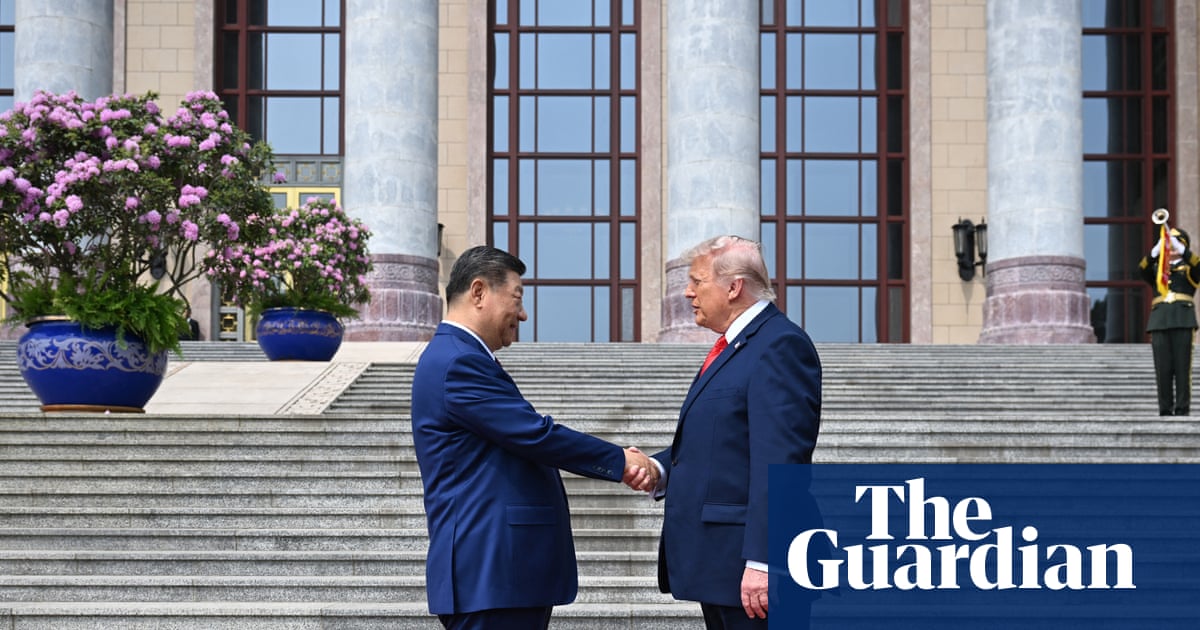
US President Donald Trump is meeting China leader Xi Jinping in Beijing, with discussions expected to cover the Iran war, trade, Taiwan and artificial intelligence. The article is a factual political update with no reported policy outcomes or market-moving announcements yet. Immediate market impact is limited, though the topics could matter for trade, tech and geopolitical risk if concrete decisions emerge.
The market implication is less about the photo-op and more about whether this meeting reduces policy volatility premia across three asset baskets: semis/AI supply chain, China-exposed industrials, and oil-linked geopolitics. Even a modest de-escalation in rhetoric would likely compress implied volatility in Asia and US tech names that have been trading on headline risk rather than fundamentals. The first-order winner is quality mega-cap tech with China revenue sensitivity, but the second-order beneficiary is the broader industrial capex complex if the meeting lowers the probability of fresh export controls or retaliation. The larger asymmetric risk is that the agenda couples trade with AI and security, which can produce a false sense of détente while actually hardening policy in specific choke points. If the two sides settle on symbolic cooperation but leave semiconductor, cloud, and advanced manufacturing restrictions intact, the result could be a rotation into “domesticization” beneficiaries rather than broad China exposure. That favors US fabrication, equipment, and grid/infrastructure names over consumer cyclicals with China demand beta. The war discussion around Iran introduces an oil-volatility tail that is underpriced if investors assume diplomacy implies stability. Any sign that China wants to preserve energy supply lanes while the US seeks burden-sharing could push Brent higher via a geopolitical-risk premium even without immediate barrels lost. Over a days-to-weeks horizon, options on crude and defense names may react faster than cash equities; over months, the dominant driver is whether rhetoric translates into actual export-control or tariff policy. The consensus may be overestimating the chance of a broad trade thaw and underestimating the chance of selective détente paired with tighter strategic competition. That would be bullish for market narrative but not necessarily for China beta, which tends to rally on headline peace only to give it back when implementation details emerge. In that scenario, buying the event and fading the follow-through is likely superior to betting on a durable regime shift.
AI-powered research, real-time alerts, and portfolio analytics for institutional investors.
Request DemoOverall Sentiment
neutral
Sentiment Score
0.00
