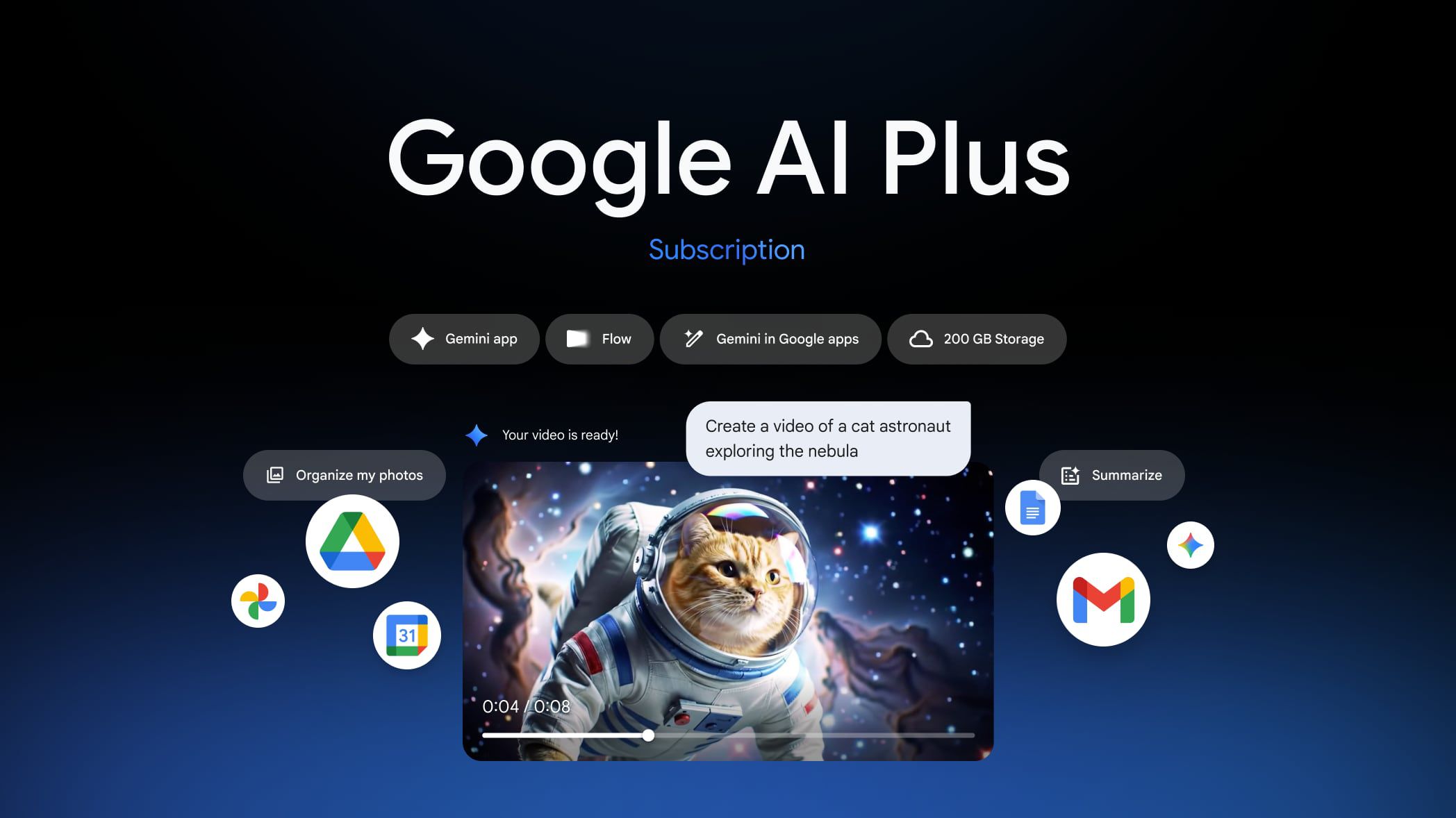
Google is rolling out a lower‑cost AI subscription, Google AI Plus, to 35 countries including the U.S., priced at $7.99/month (introductory $3.99 for the first two months). The plan bundles Gemini 3 Pro, Nano Banana Pro, Flow filmmaking tools, NotebookLM research/writing assistance, 200GB of shareable storage and 200 monthly AI video credits, while Google One 2TB customers will automatically receive the benefits; Google AI Pro remains a $19.99/month premium tier with broader features and 2TB storage. The move materially lowers the entry price for upgraded Gemini access and could broaden monetization and cross‑sell opportunities for Google’s consumer AI offerings, though it is unlikely to be a major near‑term market mover on its own.
Market structure: Google’s $7.99 AI Plus lowers the entry price for advanced LLM access, directly benefiting GOOGL/GOOG by increasing paid-user conversion and upsell into Google One; expect modest ARPU compression but higher volume — a 1–3% incremental paid-conversion in the U.S. over 6–12 months could add $0.5–$1.5B ARR (back-of-envelope). Competitors that rely on pure-play subscription AI (smaller SaaS startups) face margin pressure and user churn; Nvidia (NVDA) and Google Cloud capacity suppliers are indirect beneficiaries from higher inference demand. Cross-asset: risk-on tilt likely compresses US IG spreads and slightly lifts equities; semiconductor commodities (GPUs) see demand tailwinds, FX/bond moves minimal unless adoption materially surprises consensus.
Risk assessment: Tail risks include regulatory/antitrust probes (EU/US privacy or bundling cases) and major operational outages that could reverse subscriber trust — these are low probability but could knock 8–15% off GOOGL trading multiples in 3–12 months. Immediate effects (days–weeks): promo drives engagement spikes and search/ad elasticity tests; short-term (months): measurable sub growth and storage attach rates; long-term (quarters/years): monetization depends on retention and margin mix versus ad revenue. Hidden dependency: compute supply (NVDA GPUs, datacenter power) and cross-sell execution to Google One Premium; catalyst timeline: next earnings, Google I/O, and any regulatory filings in 30–90 days.
Trade implications: Core trade — establish a 2–3% long position in GOOGL (GOOGL) over next 2–6 weeks to capture subscriber rollouts and cross-sell synergies; size to limit portfolio concentration risk. Use 3–6 month call spreads (debit spreads ~5–10% OTM) to lever upside while capping premium; hedge tail risk with 6–9 month OTM puts if regulatory headlines spike. Complement with a 1–2% long in NVDA (calls or stock) to play GPU demand; consider a pair trade long GOOGL / short C3.ai (AI) 1:0.5 to express quality-differential in AI monetization.
Contrarian angle: Consensus views treats this as marginal consumer news; miss is underestimating the distribution leverage from bundling (200GB + family sharing) which could raise lifetime value by >20% if retention >12 months. Conversely, market may be under-pricing regulatory risk — if EU/US force unbundling or restrict data use, downside could be material and rapid. Historical parallels: Apple’s service-tier expansion initially compressed ARPU but increased long-term ecosystem revenue; unintended consequence here is accelerating infrastructure cost and capex cadence for Google and suppliers, potentially pressuring margins in next 4–8 quarters.
AI-powered research, real-time alerts, and portfolio analytics for institutional investors.
Request DemoOverall Sentiment
mildly positive
Sentiment Score
0.28
Ticker Sentiment
