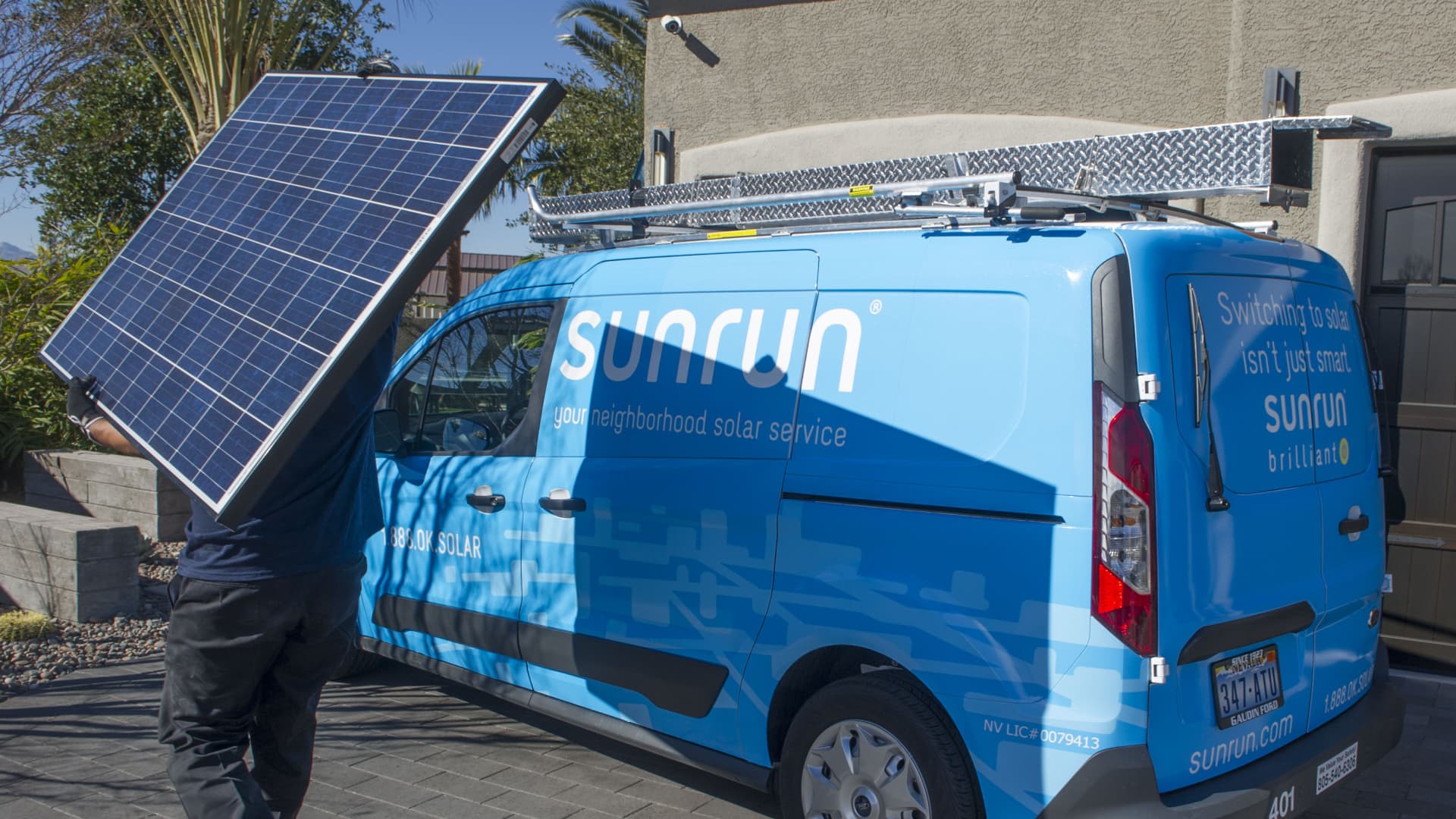
The U.S. Senate's draft tax bill is negatively impacting rooftop solar companies like Sunrun and SolarEdge, whose shares have declined significantly due to accelerated subsidy cuts and the termination of Section 25D tax credits, leading to downgrades from investment banks like KeyBanc and RBC. While the rooftop solar sector faces challenges, utility-scale solar projects supplying corporations like Meta and Amazon are expected to be more resilient due to strong demand, favorable economics, and a lack of viable alternatives, although a provision impacting First Solar's manufacturing tax credit introduces some uncertainty.
The U.S. Senate's draft tax bill is poised to significantly disrupt the rooftop solar industry, while offering a more stable outlook for large-scale renewable energy operators. Shares of rooftop solar firms Sunrun (RUN) and SolarEdge (SEDG) have plummeted by 36% and 29% respectively, with supplier Enphase Energy (ENPH) dropping 20%, following the bill's proposal to accelerate subsidy cuts and terminate Section 25D homeowner tax credits. This legislative change has prompted investment banks like KeyBanc Capital Markets to downgrade these stocks to "Underweight," citing an "ongoing and overwhelming regulatory overhang" that challenges their business models. RBC Capital Markets echoed this sentiment, slashing price targets for Sunrun by 58% and Enphase by 44%, and highlighting that the bill could box out residential solar from tax credits, exacerbating existing pressures from higher interest rates on consumer financing, as evidenced by the recent bankruptcy of Sunnova (NOVA). Conversely, the utility-scale solar market, which serves corporate clients like Meta (META) and Amazon (AMZN) via operators such as AES Corp (AES), is expected to be more resilient. This resilience stems from strong, inelastic demand from large corporations for whom energy is a smaller cost component, the impracticality and longer lead times of alternatives like gas or nuclear power, and the fact that these projects are not limited by the residential leasing restrictions. RBC Capital Markets notes utility solar's cost-competitiveness even without tax credits. However, a surprise provision in the bill targets First Solar (FSLR), America's largest panel manufacturer, by potentially repealing the "stacking" of manufacturing tax credits, which could reduce its benefit per watt from $0.17 to $0.07. Despite this, some analysts, like Per Lekander, view First Solar's subsequent stock decline as a "great buying opportunity," suggesting the market has mispriced the stock.
AI-powered research, real-time alerts, and portfolio analytics for institutional investors.
Request DemoOverall Sentiment
strongly negative
Sentiment Score
-0.70
Ticker Sentiment
