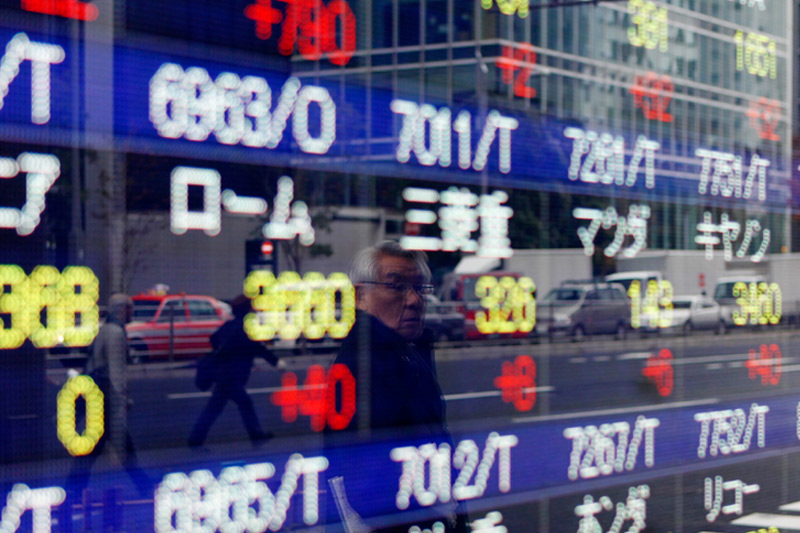
Asian stocks exhibited mixed performance Thursday as revived trade war concerns, spurred by President Trump's impending tariff announcements and hardline negotiation stance, overshadowed optimism from the recently reached U.S.-China trade framework; the lack of specific details regarding the agreement further dampened sentiment, contributing to slight declines in Chinese indexes while geopolitical tensions in the Middle East and rising oil prices also weighed on risk appetite.
Asian equity markets presented a mixed performance, reflecting heightened investor caution stemming from multiple headwinds. U.S. President Trump's warning of impending trade tariffs on major economies in the coming weeks, coupled with a hardline negotiating stance characterized as "take it or... leave it," significantly tempered earlier optimism surrounding a U.S.-China trade framework. The lack of substantive details on this purported agreement further eroded sentiment, contributing to slight declines in Chinese benchmarks; the Shanghai Shenzhen CSI 300 and Shanghai Composite indexes edged lower, while Hong Kong’s Hang Seng shed 0.5%. Notably, Chinese electric vehicle manufacturers BYD Co (1211.HK) and NIO Inc (9866.HK) experienced declines exceeding 2%, reflecting both broader trade anxieties and specific local factors. Rising geopolitical tensions in the Middle East, evidenced by the U.S. personnel evacuation from Iraq and concerns over Iran's nuclear program, pushed oil prices higher and broadly weighed on risk appetite, although commodity-exposed indexes like Australia’s ASX 200 saw a 0.2% gain, buoyed by energy and gold mining stocks. Japanese markets were notable underperformers, with the Nikkei 225 and TOPIX falling 0.8% and 0.4% respectively, influenced by a resilient yen and weakness in local technology stocks. In contrast, South Korea’s KOSPI emerged as an outlier, advancing 0.5% to a 3-½ year high, supported by optimism over political stability and an anticipated earnings recovery. Singapore’s Straits Times index also rose 0.3%, and Indian Nifty 50 futures pointed to a positive open, partly on news of Reliance Industries' potential investment in OpenAI. The overall market environment is consistent with the provided moderately negative sentiment score (-0.35) and uncertain tone.
AI-powered research, real-time alerts, and portfolio analytics for institutional investors.
Overall Sentiment
moderately negative
Sentiment Score
-0.35
Ticker Sentiment
