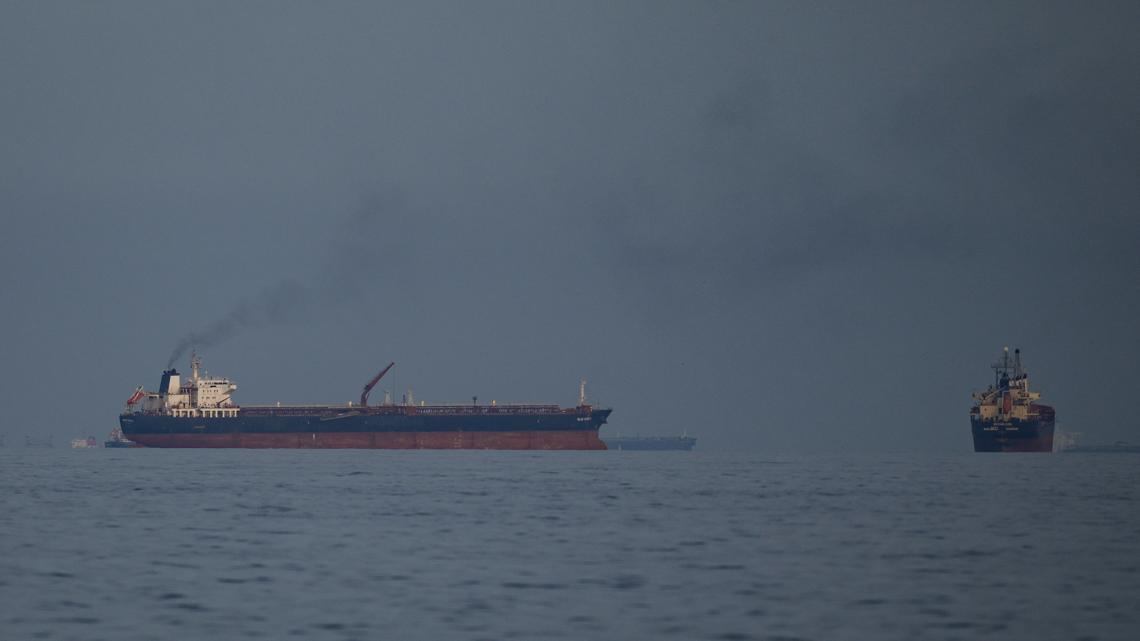
Brent jumped >7% to over $108/bbl and U.S. crude rose ~7% to about $107/bbl after President Trump's April 1 Iran speech, while stock markets slipped. Roughly 20 million bpd transit the Strait of Hormuz (≈5 million bpd to China) and the U.S. receives about 500,000 bpd via the strait; U.S. refineries process ~60% domestic crude but depend on imported heavy crude (≈60% from Canada, 7% from Mexico). AFPM says retooling refineries to accept only light domestic crude would cost 'billions' and take 'decades,' and Iran could impose ~$2m per-tanker fees (≈$20m/day; ~$600m/month), posing a sustained upside risk to oil prices and increased market volatility.
The market reaction priced a near-term logistical shock rather than a permanent structural shortage; that implies the winners will be those exposed to transport and insurance dislocations rather than simply crude owners. Longer voyage distances and rerouted cargoes raise marginal shipping demand and time-charter rates, which compounds quickly because VLCC/Suezmax capacity is fixed in the short run and owners monetize scarcity through spot premiums and storage-in-transit.
Refinery economics will bifurcate: high-complexity plants with cokers/hydrocrackers can flex more feedstock blends and capture widening differentials, while simpler units face margin compression if cheaper arbitrage barrels go offline. The capital and permitting calendar makes rapid configuration changes unrealistic, so earnings divergence among refiners will persist for quarters-to-years and show up first in regional crack spreads and inventory turns.
A toll or quasi-tax on transits effectively creates a persistent variable shipping surcharge embedded in seaborne prices and LNG trucking economics; that acts like a per-ton transport tariff and is more inflationary for distant buyers than a one-off production cut. Politically driven reopening is the highest-probability fast de-risk event, but asymmetric escalation or formalized tolling creates a multi-quarter premium in freight, insurance, and inventory holdings that also raises counterparty and trade finance risk for banks financing shipments.
Behavioral/capital-flow knock-ons matter: insurance and P&I rates will lead banks and trading houses to tighten collateral terms, favoring vertically integrated players with balance-sheet capacity. That dynamic amplifies advantage for majors and certain trading houses while stranding independent refiners and merchants that rely on short-term credit lines.
AI-powered research, real-time alerts, and portfolio analytics for institutional investors.
Request DemoOverall Sentiment
neutral
Sentiment Score
0.00
