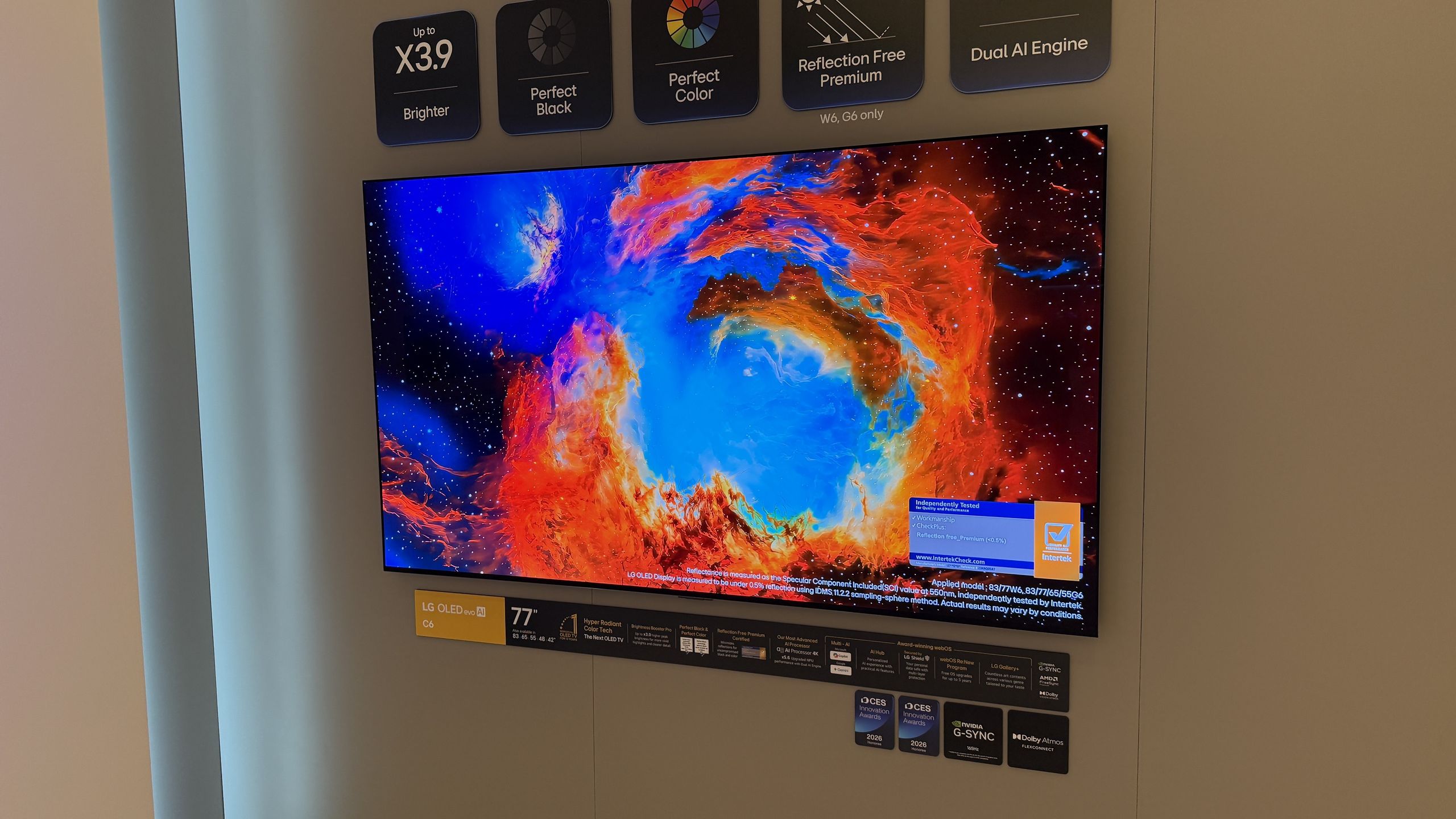
LG unveiled its 2026 OLED lineup at CES, led by the flagship OLED evo G6 which uses a Primary RGB Tandem 2.0 panel with Brightness Booster Ultra delivering a claimed 20% brightness increase versus the G5 and sub-0.5% screen reflectance; the G6 also offers 4K 165Hz support, Motion Booster to 1080p@330Hz, and the industry’s first built-in 4K 120Hz cloud gaming with ultra-low-latency Bluetooth controller support. The C6 series splits into C6 (42–65") and C6H (77"/83") — the latter adopting the Tandem panel for G5-like brightness — and LG also reintroduces a 9.9mm Wallpaper W6 with a wireless Zero Connect box, new QNED mini-LEDs up to 115", and expanded AI features (Alpha 11 Gen 3, webOS AI Hub with Copilot/Gemini, AI upscaling). These product and AI advances should bolster LG’s premium TV positioning and could influence unit mix and ASPs, though no pricing, sizes availability, or financial guidance were announced.
Market structure: LG’s CES slate pushes premium OLED and cloud-gaming integration, favoring GPU/cloud-infrastructure vendors (NVDA) and panel suppliers (OLED makers) while pressuring lower-tier TV makers and standalone console peripherals. Expect ~5–15% ASP uplift in the premium TV segment if LG converts even 10–15% of prior generation sales to G6/W6 placements; that raises demand for cloud-gaming capacity and low-latency Bluetooth controllers. Platform competition (webOS AI Hub vs. Roku/Fire) nudges monetization by OS owners upward and could shift ad/OS revenue shares across smart-TV ecosystems over 12–24 months.
Risk assessment: Key tail risks include failed consumer take-up (discretionary spending shock), NVIDIA supply constraints or cloud-provider contract friction, and content/AI licensing dependency (LG’s Gemini/Copilot tie-ups) that could be renegotiated or restricted. Near term (days–weeks) the market will reprice on availability/pricing announcements; medium term (3–12 months) depends on shipment cadence and holiday-season sell-through; long term (2–4 years) depends on cloud-gaming TAM adoption and OLED capacity expansion. Hidden dependency: cloud-gaming upside requires data-center GPU supply and low-latency network partners; shortages amplify hardware suppliers’ pricing power.
Trade implications: Directly, overweight NVDA via options or equity for 6–12 months to capture cloud-gaming and AI inference demand; underweight/hedge Roku (ROKU) vs. NVDA as a relative-play because LG’s OS improvements compress Roku’s platform premium. Use 3–6 month option structures to control capital (e.g., NVDA 20–30% OTM call spreads; ROKU short-dated puts or short equity if shares rally). Rotate sector exposure into semicap equipment and data-center REITs on confirming supply-chain orders.
Contrarian angles: Consensus may overvalue immediate sell-through — inventory push and margin-skirting promotions could keep ASPs under pressure in H1 2026; NVDA’s cloud demand is real but partly priced into multiples and high IV, so avoid naked long gamma. Consider selling short-dated NVDA call spreads if IV > historical 90-day by >20% and pair with small long-dated exposure; likewise, LG’s new subscription (Gallery+) may under-monetize, leaving smart-TV ad rev growth below expectations.
AI-powered research, real-time alerts, and portfolio analytics for institutional investors.
Request DemoOverall Sentiment
mildly positive
Sentiment Score
0.35
Ticker Sentiment
