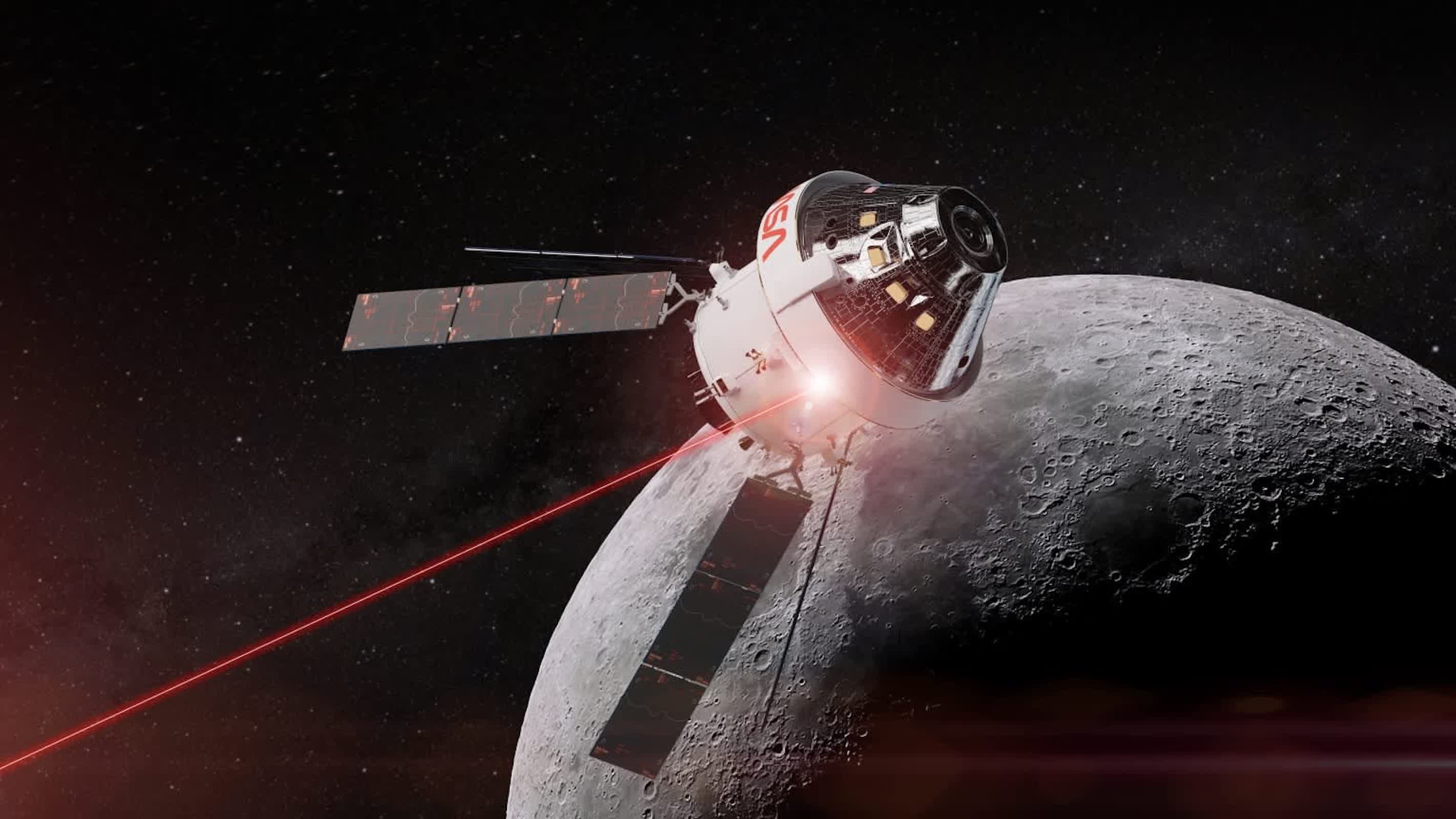
NASA's Artemis II will use the O2O laser communications system to send 4K video from ~240,000 miles at up to 260 Mbps, with laser ground stations in Las Cruces (NM) and Table Mountain (CA). The system frees mass/space aboard Orion versus radio, keeps the Deep Space Network as a radio backup, and accepts a planned 41-minute blackout behind the Moon; prior demonstrations reached 622 Mbps and near-Earth tests 200 Gbps, suggesting room for future scaling.
Optical deep‑space communications create an architectural fork: missions that can support line‑of‑sight laser terminals will trade hardware mass and RF bandwidth costs for higher per‑mission data throughput and new payload economics. That change lowers the marginal cost of returning high‑value science and media content, but it does not automatically translate into revenue — widespread monetization requires a ground‑station footprint, transport/routing infrastructure, and commercial SLAs that will take multiple procurement cycles to build out (think 2–5 years for meaningful commercial TAM growth).
The immediate supply‑chain winners are the specialists: space‑qualified lasers, fast steering mirrors, single‑photon detectors and adaptive‑optics vendors — plus systems integrators that can turn those components into field‑reliable terminals. Second‑order beneficiaries include firms that build or operate clear‑sky ground infrastructure and those that can rapidly scale precision optics manufacturing; conversely, incumbents whose value is concentrated in licensed RF spectrum and large, heavy RF payloads face margin pressure if optical terminals become the preferred uplink/downlink layer for high‑volume missions.
Key fragilities are operational rather than conceptual: weather dependence, ground‑station density, targeting/pointing complexity and radiation‑hardened component yield. Near‑term catalysts that will move valuations are contract awards and constellation announcements that commit to building optical ground networks; negative shocks that could unwind enthusiasm include clustered hardware failures, adaptive optics shortfalls in real operations, or an incumbent RF vendor introducing a lower‑cost, higher‑throughput hybrid solution. Expect volatility around procurement decisions over the next 6–18 months as the market tests tradeoffs between proven RF backups and nascent optical stacks.
AI-powered research, real-time alerts, and portfolio analytics for institutional investors.
Request DemoOverall Sentiment
mildly positive
Sentiment Score
0.30
