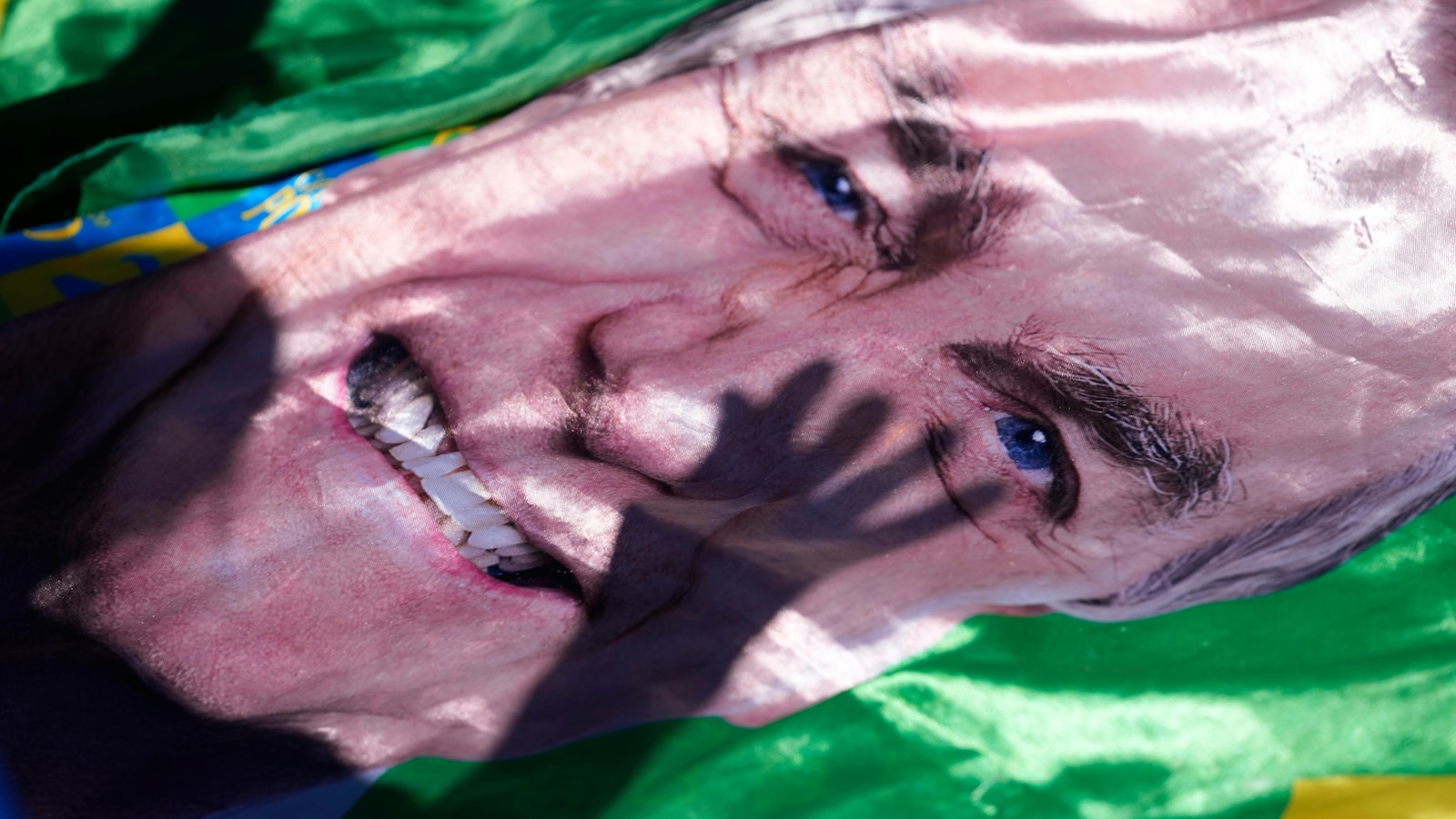
Former Brazilian President Jair Bolsonaro was discharged from a Brasilia hospital a week after an uncomplicated double hernia surgery and was returned to the federal police headquarters to continue serving a 27-year prison sentence for leading a plot to overturn Brazil’s 2022 election. Brazil’s Supreme Court cleared the surgical leave but denied his request for house arrest; the conviction and Bolsonaro’s recent move to name his son as his party’s 2026 presidential candidate increase political uncertainty ahead of next year’s election and pose localized political risk for Brazilian assets and investor sentiment.
Market structure: Bolsonaro’s return to custody raises Brazil-specific political risk and a near-term risk premium on domestic assets. Direct losers: domestic-facing banks (Itaú ITUB, Bradesco BBD) and consumer-discretionary names that depend on local consumer confidence; relative winners: exporters (miners VALE, oil PBR) whose revenues are USD-linked and less sensitive to local political noise. Expect higher idiosyncratic volatility in EWZ and BRL spot, with modest upward pressure on sovereign spreads if protests escalate.
Risk assessment: Tail risks include widescale unrest that forces temporary capital controls or delays elections (low-probability, high-impact) — model a +50–150bp move in Brazil 5y CDS and a 5–15% BRL depreciation in stressed scenarios within 1–3 months. Immediate (days) effect = higher realized vol; short-term (weeks–months) = potential outflows from EM local debt and equities; long-term (quarters–years) = outcome contingent on 2026 election dynamics and policy continuity under Lula. Hidden dependency: central bank FX intervention capacity and foreign investor positioning (carry/hedge ratios) will determine amplitude.
Trade implications: Tactical defensive positioning: overweight USD/BRL (or buy BRL puts) and buy protection on sovereign credit if CDS cheapens; rotate exposure from domestic banks to commodity exporters (long VALE, PBR) for 3–6 months. Use options to control risk: buy 3-month BRL call/put structure or EWZ put spreads (buy 10% OTM, sell 5% OTM) to cap cost, and pair long VALE vs short ITUB to isolate political vs commodity beta.
Contrarian angles: Consensus may overprice persistent instability — if protests remain contained, a reversion rally in local equities (especially exporters) is possible within 1–2 months; historical parallels (post-2016 political shocks) show 10–25% rebounds in select sectors. Risk: a stabilized but more authoritarian outcome could lead to policy uncertainty that impairs capex; set clear stop-loss triggers (BRL move >-7% or CDS widening >100bp).
AI-powered research, real-time alerts, and portfolio analytics for institutional investors.
Request DemoOverall Sentiment
mildly negative
Sentiment Score
-0.25
