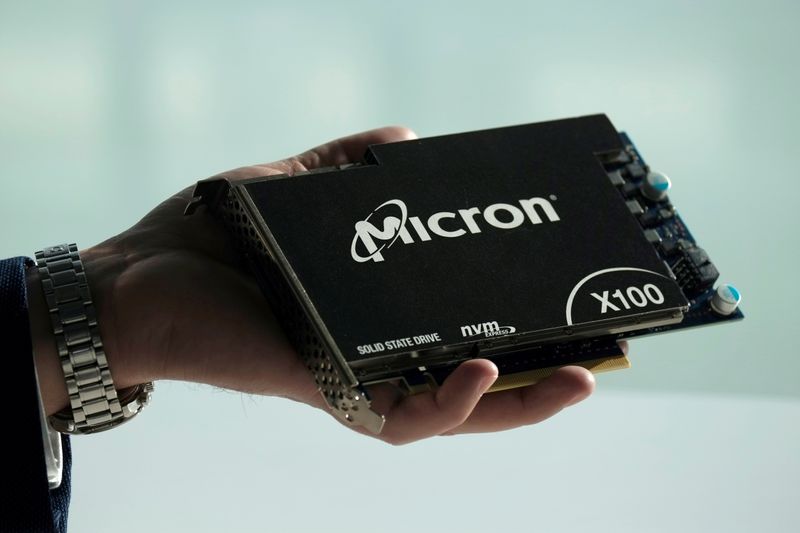
Micron reported Q2 revenue that nearly tripled and provided fiscal Q3 guidance above expectations, but shares fell ~5% premarket amid a higher-capex plan driven by cleanroom investments. RBC reiterated an Outperform with a $525 target while Needham, Morgan Stanley, Raymond James and Stifel raised targets to $500, $520, $530 and $550 respectively; Morgan Stanley highlighted guidance of $19.15 EPS vs $12 consensus. Management cited >50% data-center mix and HBM representing >20% of DRAM industry; RBC expects healthy pricing into 2027 despite near-term supply/peak-margin concerns.
The recent enthusiasm around memory stocks is creating a bifurcated opportunity set: semiconductor capital-equipment and specialty materials suppliers will capture spend that is front-loaded and stickier than fab-level bit supply, while large integrated memory producers stand to convert pricing power into free cash if inventory discipline holds. Expect lead-time effects — longer for new cleanroom/wafer investment and shorter for tool purchases — which will shift where incremental margin accrues across the chain over the next several quarters. Key risks cluster around demand elasticity and supply timing. On the demand side, efficiency gains in model training or a brief pause in hyperscaler procurement could reduce marginal DRAM/HBM absorption; on the supply side, accelerated capacity additions by large Asian incumbents or an unanticipated restart of curtailed lines could compress ASPs within a few quarters. Watch spot price indices and OEM GPU billings as near-term pulse checks; reserve a 3–9 month horizon for inventory normalization and 12–24 months for structural capacity shifts to show up in pricing. Tradeable asymmetries favor optionality and pairings rather than outright long single-name exposure at current sentiment; long-dated call structures on the leader give upside with defined risk, while long exposure to niche equipment names provides a levered play on non-equipment parts of the capex cycle. Conversely, tactical shorts or hedges against broader memory cyclicals can pay off if spot pricing deteriorates or if mix shifts toward lower-margin products accelerate. The consensus is underestimating two things: the timing mismatch between cash spent today and bits delivered later, and the sensitivity of margins to product mix (HBM-like SKUs can raise ASPs but also raise cost-per-bit and capital intensity). Monitor weekly spot DRAM reports, fab utilization, and hyperscaler GPU purchase cadence as the primary catalysts that will validate or reverse the current multiple expansion narrative.
AI-powered research, real-time alerts, and portfolio analytics for institutional investors.
Request DemoOverall Sentiment
moderately positive
Sentiment Score
0.60
Ticker Sentiment
