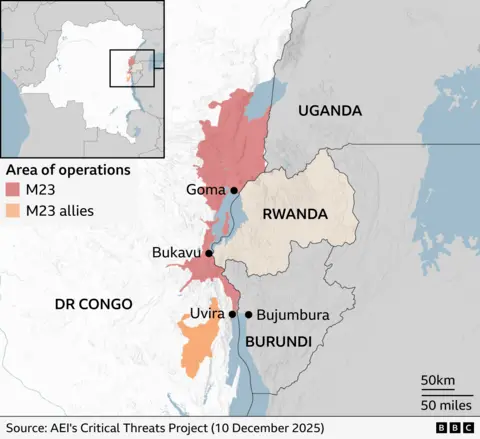
Days after a US-hosted Washington ceremony in which DR Congo's Félix Tshisekedi and Rwanda's Paul Kagame signed a touted peace accord, the M23 rebel group — accused by the US, EU and UN experts of being backed by Rwanda, which denies the charge — seized the strategic city of Uvira in South Kivu. Uvira (population ~700,000) lies 27km from Burundi, its capture severs a gateway used by at least 10,000 Burundian troops, has driven roughly 50,000 people into Burundi and is likely to be turned into a parallel administration or bargaining chip in stalled talks. The offensive undermines both the Washington and Doha peace processes, jeopardizes planned economic cooperation on mining, hydropower and infrastructure that U.S. backers hoped would attract investment, and significantly raises the risk of wider regional escalation that could deter investors and complicate international policy responses.
M23 rebels seized the strategic city of Uvira in South Kivu days after DR Congo's Félix Tshisekedi and Rwanda's Paul Kagame signed a Washington peace accord, with the offensive occurring while the leaders were ratifying the deal. Uvira, about 27km from Burundi and home to roughly 700,000 people, severs a supply gateway used by an estimated 10,000 Burundian troops and has driven approximately 50,000 refugees into Burundi, amplifying regional humanitarian strain.
The US, EU and UN have accused Rwanda of backing M23 operations—allegations Rwanda denies—while the M23 was not a signatory to the Washington accord and has been negotiating separately in Doha; US Ambassador Mike Waltz warned Rwanda is steering the region toward war. Key peace-process elements, including disarmament operations against the FDLR and proposed economic cooperation on hydropower, mining and infrastructure, are now described by experts as unlikely to proceed while fighting and alleged foreign troop presence persist.
Operationally, analysts estimate M23 has more than 10,000 fighters with likely Rwandan military support and superior drone use cited as a factor in recent advances, and the group is expected to establish parallel administration in Uvira to strengthen negotiating leverage. The combination of renewed conflict, stalled negotiations and public international rebukes raises political-risk premia for investors tied to eastern DR Congo projects and increases the probability of broader regional escalation that could disrupt commodity-related investments and timelines.
AI-powered research, real-time alerts, and portfolio analytics for institutional investors.
Request DemoOverall Sentiment
moderately negative
Sentiment Score
-0.60
