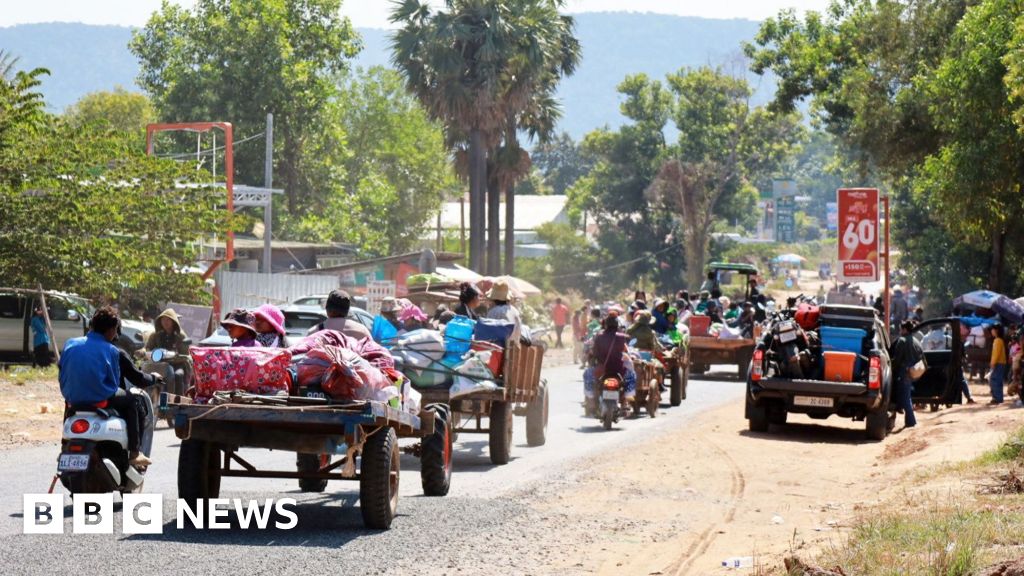
Fresh clashes along the Thailand–Cambodia border killed at least five people (one Thai soldier and four Cambodian civilians), wounded around a dozen, and triggered mass evacuations and cross-border accusations as Thai forces reported air strikes and Cambodia reported attacks in Preah Vihear. The violence—the worst since July’s ceasefire—has led to import bans, travel restrictions and the closure of nearly 650 schools across five Thai provinces, creating localized disruption to trade, tourism and regional stability while posing limited broader market impact unless the conflict escalates further.
Market structure: Immediate winners are cash/FX safe-havens (USD, JPY) and regional defensive sectors (global defense primes, select commodity exporters); losers are Thailand/Cambodia local tourism, cross-border logistics, and frontier asset classes. Expect 1–3% near-term underperformance in Thailand equity indices and a 0.5–1.5% depreciation in THB if fighting continues beyond a week, pressuring USD/THB and raising local sovereign bond spreads by ~10–30bp. Commodity supply shocks are localized (rice, construction aggregates) but could lift short-term freight and insurance premia.
Risk assessment: Tail risks include protracted border war forcing multi-week closures (low probability, high impact) or ASEAN sanctions that freeze tourism flows—each could shave 1–3% off Thailand GDP growth for a quarter. Time horizons: immediate (days) — flight to safety and tourism cancellations; short-term (weeks–months) — FX and sovereign spread moves, disrupted school/labor productivity; long-term (quarters–years) — potential reallocation of cross-border supply chains and incremental defense budgets. Hidden dependencies include cross-border migrant labor, SME exporters, and regional airline winter schedules that amplify economic effects.
Trade implications: Tactical plays should be small, defined and conditional. Prefer short Thailand-specific exposures (THD, AOT.BK, MINT.BK) and FX plays (long USD/THB spot or forwards), hedge with broad EM longs (EEM/AAXJ) and consider 1–3 month put spreads on THD or call spreads on USD/THB for asymmetric risk. For longer horizon, small longs in major defense primes (LMT, RTX) sized 0.5–1% for 6–12 months to capture potential regional procurement cycles.
Contrarian angles: Consensus underestimates speed of reversion if a durable ceasefire (≥60 days) is enforced — tourism and THB can rebound sharply (mean reversion ~3–5% in 30–90 days). Overreaction risk: indiscriminate EM selling yields entry for selective Asia ex-Thailand exposure; mispricing exists in options where implied vol on Thailand equities can overshoot realized vol by 30–50% during short skirmishes. Historical parallels (localized skirmishes in 2010s) show short windows for profitable mean-reversion trades rather than multi-year secular shifts.
AI-powered research, real-time alerts, and portfolio analytics for institutional investors.
Request DemoOverall Sentiment
moderately negative
Sentiment Score
-0.50
