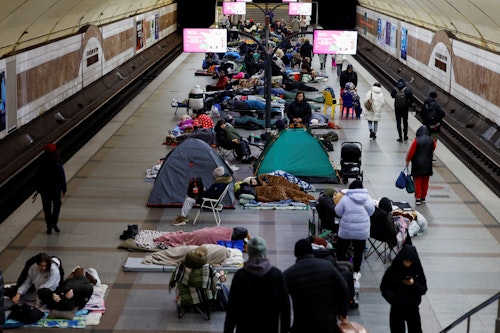
French President Emmanuel Macron will meet Ukraine's Zelensky, UK Prime Minister Keir Starmer and German Chancellor Friedrich Merz in London to review US-mediated peace talks as Kyiv and US envoys continue negotiations; Zelensky said talks with US negotiators were "long and constructive" but progress depends on Russia. Russia launched a large overnight drone and missile assault (reported as 653 drones and 51 missiles) that targeted energy and rail infrastructure, triggering regional heating and water outages (e.g., Odesa: ~9,500 without heat, 34,000 without water) and a half-hour loss of off‑site power at Zaporizhzhia NPP; Ukraine also reported strikes on Russia's Ryazan refinery and a shell-casing plant. Hungarian PM Viktor Orban announced a business delegation to Russia ahead of elections, discussing potential post-war reintegration and dismantling of sanctions—an element that could materially affect sanctions trajectories and regional energy/transport flows.
Market structure: Near-term winners are aerospace & defense contractors, specialty insurers (war/energy hull), and commodity producers (oil, uranium, thermal coal) as infrastructure strikes and tanker risks raise physical and insurance premia; expect a 3–8% shock to European gas/oil spreads if attacks persist over 2–6 weeks. Losers include European utilities and regional rail/transport operators facing disrupted fuel and power flows and rising replacement-capex; trade lanes/shadow-fleet disruption will push shipping rates and BDI volatility higher. Cross-asset: risk-off skews to USD and gold, pushes core yields down (TLT bid) while equity vol (VIX) and energy implied vols rise 20–40% on event days.
Risk assessment: Tail events include NATO escalation (<5% near-term but >50% systemic shock), a major nuclear-safety incident at Zaporizhzhia (<2% but catastrophic), or a rapid diplomatic reintegration of Russia (per Orban) that would unwind sanctions and depress commodity-driven equities. Time horizons: immediate (days) = headline-driven vol and energy spikes; short-term (weeks-months) = defense order re-rating and higher insurance/shipping costs; long-term (quarters+) = reconstruction demand and possible sanctions normalization. Hidden dependencies: shipping insurance availability, European winter gas inventories, and Hungarian election outcome as a diplomatic swing; catalysts are the London meeting readout (48–72h) and Miami talks communiqués.
Trade implications: Favor a 2–3% tactical overweight in U.S. aerospace & defense (ETF ITA or names LMT, RTX) for 3–6 months to capture re-rating if strikes continue; hedge with 1–2% GLD and short-duration Treasury exposure capped at 1–2% (buy TLT on sharp risk-off). Energy: overweight XLE/BNO (3% position) for 1–3 months, add if Brent > $90; use 1–3 month call spreads to limit premium. Use options to express event risk: buy 30–60 day VIX call spreads (size 0.5–1% notional) ahead of London/Miami readouts and buy 3-month LMT/RTX 5–10% OTM call spreads for convex upside with capped cost.
Contrarian angles: Consensus assumes protracted conflict; dissenting risk is rapid partial reintegration of Russian trade which would compress commodity prices and trigger a 10–25% downside in defense/energy names within 30–90 days. The market may be overpaying for defense exposure on headline volatility alone—use call spreads, not naked longs, and size at 2–3% of equity risk budget. Historical parallels (2014–15 sanctions cycle) show ~6–9 month mean reversion if diplomatic breakthroughs emerge; position sizing should be dynamic and event-contingent.
AI-powered research, real-time alerts, and portfolio analytics for institutional investors.
Request DemoOverall Sentiment
moderately negative
Sentiment Score
-0.60
