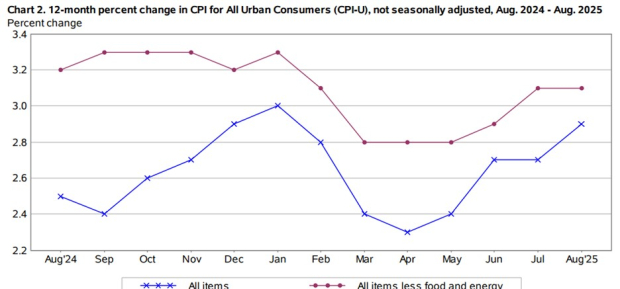
August's Consumer Price Index (CPI) registered a headline increase to 2.9% year-over-year and 0.4% month-over-month, exceeding July's figures, yet the Federal Reserve's preferred core CPI remained stable at 3.1% YoY and 0.3% MoM, aligning with economist expectations. This data fueled market optimism for a 25 basis point rate cut, propelling the S&P 500 and Nasdaq to new highs. Shelter costs were the primary monthly contributor to inflation, potentially benefiting homebuilders, while rising food and transportation prices indicate a bifurcated impact on consumer spending, favoring essential goods retailers but challenging discretionary sectors.
The August CPI data presents a bifurcated inflation narrative that supported market optimism for a Federal Reserve rate cut. While headline CPI accelerated month-over-month to 0.4% and year-over-year to 2.9%, the Fed's preferred core CPI metric held steady at a 0.3% monthly and 3.1% annual increase, matching July's figures. This stability in core inflation reinforced market expectations for a modest 25 basis point rate cut, driving the S&P 500 and Nasdaq to new highs. A sectoral breakdown reveals distinct winners and losers: shelter costs, the largest contributor with a 0.4% monthly rise, may benefit homebuilders like Toll Brothers (TOL) as climbing rents incentivize home purchasing amidst low mortgage rates. In consumer goods, rising food costs (+0.5% MoM) appear to favor value-oriented retailers like Walmart (WMT) but are pressuring discretionary dining, as evidenced by Chipotle's (CMG) stock trading near 52-week lows. Transportation saw significant price hikes in airline fares (+5.9% MoM) and used cars (+1.0% MoM), suggesting pricing power for firms like Delta (DAL), which raised its Q3 revenue guidance, and a potential consumer shift to new vehicles, benefiting automakers like General Motors (GM). Finally, the 0.5% monthly increase in apparel costs highlights potential tariff impacts, favoring companies with strong pricing power and brand recognition like Ralph Lauren (RL), which has seen its stock gain 35% year-to-date, over struggling peers.
AI-powered research, real-time alerts, and portfolio analytics for institutional investors.
Overall Sentiment
moderately positive
Sentiment Score
0.50
Ticker Sentiment
