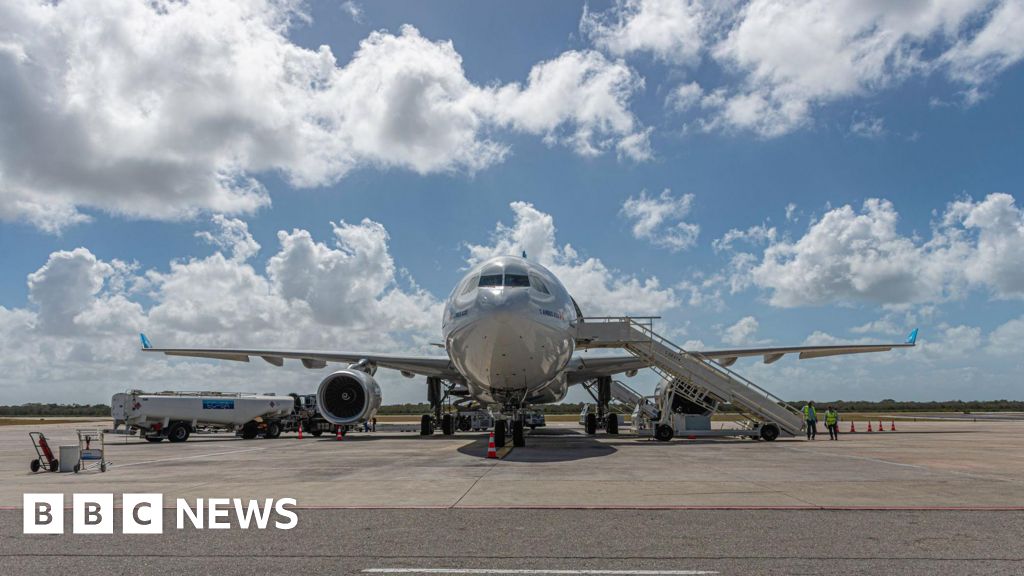
Air Canada suspended all service to Cuba effective Monday and will repatriate roughly 3,000 customers as a NOTAM warned aviation fuel will be unavailable at Cuban airports from Tuesday until at least March 11; about 16 weekly flights to four Cuban destinations from Toronto and Montreal are on hold. The shortage is tied to diminished Venezuelan jet-fuel supplies after U.S. action against Venezuelan exports and escalating U.S. threats of tariffs on countries supplying oil to Cuba, raising geopolitical tail risks for regional fuel logistics and creating operational disruption for carriers; Air Canada is monitoring conditions to resume service.
Market structure: Direct losers are Air Canada (AC.TO) on near-term revenue and ops disruption; Cuban tourism operators and any travel insurers with concentration in Cuba will also be hit. Winners are regional fuel suppliers/refiners (Atlantic-facing refiners and distributors such as Suncor SU.TO and Parkland PKI.TO) and carriers that maintain service (WestJet WJA.TO, Air Transat), which can pick up share and raise fares on rerouted itineraries. The NOTAM through Mar 11 implies a short, sharp regional refined-product supply shock that will widen local ULSD/jet-fuel crack spreads and lift implied vols on airline equities.
Risk assessment: Tail risks include US escalation of sanctions or tanker seizures extending shortages beyond months, forcing reroutes and increasing aviation opex materially; operational risk includes repatriation costs and aircraft idling that could shave 1–3% off quarterly pax revenues for affected carriers. Immediate window: days–weeks (repatriation, NOTAM expiry); short term: weeks–months (revenue guidance revisions); long term: quarters (route mix/market-share shifts if sanctions persist). Hidden dependencies: Cuban reliance on Venezuelan shipping corridors, insurance/flagging of tankers, and third-country intermediaries.
Trade implications: Tactical short bias on AC.TO via 1–2% portfolio position or 1–2 month put options (5–8% OTM) for a 4–8 week horizon; pair trade long WJA.TO vs short AC.TO to capture potential share gains. Long selective refiners/distributors (SU.TO or PKI.TO 1–2% positions) or ULSD (HO) futures/ETFs to capture widening jet-fuel cracks; set stop-loss if crack spread fails to widen 5% within 2 weeks. Rebalance by Mar 15 or on NOTAM removal; cut exposure if AC.TO guidance revises >2% EBITDA.
Contrarian angles: Market may overreact—Cuba flights are ~16 weekly AC services, likely <1% of system ASM, so a >4% sell-off in AC.TO would be an overhang to exploit. Historical regional fuel shortages resolve in weeks when alternate suppliers/insurance are arranged; if NOTAM lifts by Mar 11, airlines’ stocks should mean-revert. Unintended consequence: persistent sanctions could elevate Atlantic refiners’ margins materially, so avoid short positions on those names during escalation scenarios.
AI-powered research, real-time alerts, and portfolio analytics for institutional investors.
Request DemoOverall Sentiment
moderately negative
Sentiment Score
-0.35
Ticker Sentiment
