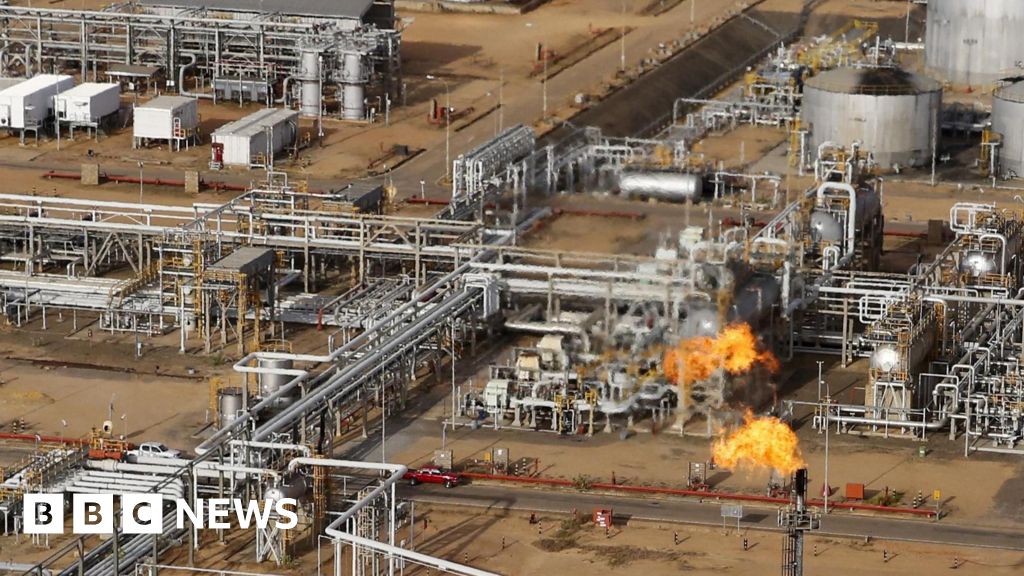
The Trump administration is proposing to enlist US oil companies to develop Venezuela’s estimated 303 billion barrels of proven reserves after seizing assets and tightening maritime controls, but current production is only ~860,000 bpd (November), roughly a third of levels a decade ago. Analysts warn that Venezuela’s heavy, sour crude, decades of underinvestment and sanctions since 2015, legal and political hurdles (contracts with a successor government) and the need for tens of billions of dollars and up to a decade of work—with Chevron currently accounting for about a fifth of output—mean any meaningful uplift in supply or global oil-price impact is unlikely in the near term.
Market structure: A successful U.S. move to exploit Venezuelan oil is a multi-year, high-capex contest that primarily benefits: (a) holders of contractual optionality (large integrated majors with existing footprints like CVX) and (b) oil services (SLB, HAL) if sanctions lift. Losers are Venezuelan sovereign/PDVSA bondholders (high default risk) and refiners in regions that already have sour capacity constraints. Net near-term global supply impact is negligible—expect <0.5 mb/d change in 12 months; material change (0.5–2.5 mb/d) requires $30–70bn and 5–10 years.
Risk assessment: Tail risks include a kinetic confrontation, a permanent sanctions regime, or expropriation—each could wipe out contractual claims and make capex sunk; low-probability but >10% downside to any on-the-ground investor. Time horizons: days (market headlines → volatility spike), weeks–months (sanctions/asset seizures → credit spread widening), years (capex + skilled labor recovery → production ramp). Hidden dependencies: access to diluent, skilled staff, export terminals and reinsurance; any single missing link delays output by years.
Trade implications: Near-term trades should be optionality/insurance rather than directional oil exposure. Prefer small, low-cost long-dated call spreads on CVX to capture upside if sanctions reverse, buy sovereign/PDVSA CDS as asymmetric protection, and overweight oil-service equipment suppliers for a 12–36 month capex cycle. Cross-asset: expect EM sovereign spreads to widen, hard-currency PDVSA bonds to underperform, shipping/insurance costs to rise and a modest risk premium in Brent if uncertainty persists.
Contrarian angles: Consensus overestimates speed and underestimates legal friction—markets are likely underpricing long-dated optionality and overpricing near-term operational upside. Historical parallels (Iraq, Libya) show multi-year timelines from political change to sustainable output increases. Unintended consequence: a drawn-out U.S. administration-run period could increase geopolitical risk premia, raising energy sector capex costs and compressing returns for anyone deploying capital prematurely.
AI-powered research, real-time alerts, and portfolio analytics for institutional investors.
Request DemoOverall Sentiment
moderately negative
Sentiment Score
-0.45
Ticker Sentiment
