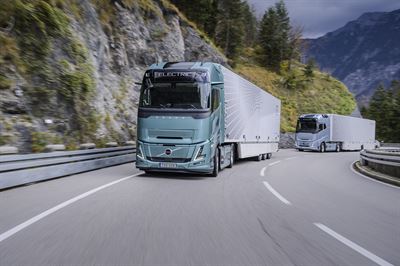
Volvo Trucks was Europe’s market leader for heavy-duty trucks (16+ tonnes) in 2025 with a 19.0% market share, up from 17.9% in 2024, driven by strong demand for its long-distance FH Aero which logged nearly 33,000 orders and delivers up to 7% better fuel efficiency versus the prior FH. The company is market leader or the second-largest brand in 30 countries, cites UK, France, Poland, Germany and Lithuania as top markets, and is pursuing a three-path technology strategy (battery-electric, fuel-cell electric and renewable-fuel combustion) to reach net-zero by 2040.
Market structure: Volvo Group (VOLV‑B) is the primary beneficiary — a rise to 19.0% share (from 17.9%) and 33k FH Aero orders signals durable product-led share gains in European heavy trucks (16t+). Competitors (Traton TRAT3, Daimler Truck DTG.DE, Paccar PCAR, CNHI) face pressure to match aero/fuel-efficiency features, limiting pricing power over 6–18 months even as Volvo can command a modest premium for demonstrable 7% fuel savings.
Risk assessment: Key tail risks are (1) supply-chain disruptions (semis/battery cells) that could delay BEV/FCEV rollouts, (2) regulatory shifts (EU heavy‑duty ZEV mandates) that accelerate capex and depress short‑term margins, and (3) demand shocks from a European recession that pull forward used‑truck supplies. Immediate (days) impact is limited to sentiment; short term (1–6 months) margins and order cadence matter; long term (1–5 years) capex intensity and infrastructure roll-out determine market leadership sustainability.
Trade implications: Tactical trades should express conviction in Volvo’s product lead while hedging competitor catch‑up risk. Prefer long VOLV‑B exposure sized 2–3% of equity risk budget for 6–12 months; execute pair trades (long VOLV‑B vs short TRAT3/DTG.DE) to isolate product premium. Use 9–12 month call spreads on VOLV‑B to capture optionality at controlled cost; selectively overweight suppliers of aero/efficiency tech and battery/hydrogen supply chains.
Contrarian angles: Consensus underestimates that a 7% fuel‑save truck could extend replacement cycles and thus depress unit demand 1–3% annually — a structural offset to share gains. Historically (truck tech cycles 2008–2015) competitors closed gaps within 12–18 months, so position sizing and catalyst monitoring (fleet orders, EU regs, battery supply announcements) must be precise to avoid mean reversion losses.
AI-powered research, real-time alerts, and portfolio analytics for institutional investors.
Request DemoOverall Sentiment
moderately positive
Sentiment Score
0.55
