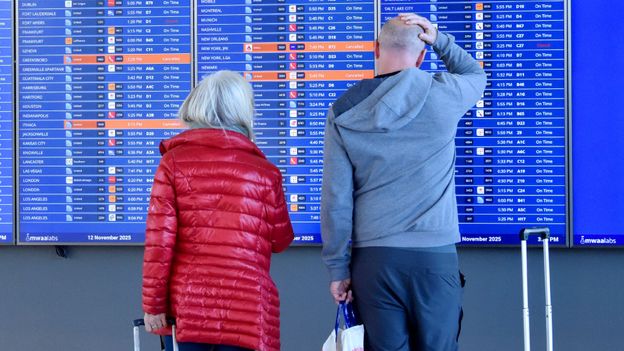
Following a 43-day US government shutdown that forced TSA officers and air traffic controllers to work without pay and prompted an FAA emergency order with flight reductions, Congress funded the government and restrictions have been lifted ahead of Thanksgiving. AAA forecasts nearly 82 million Americans will travel at least 50 miles this holiday (about 73 million by car, +1.3 million vs. last year), and industry officials expect air operations to stabilize within days but warn of lingering staffing shortfalls — nearly 3,000 controller vacancies — that could weigh on travel capacity and service quality over the medium term.
Market structure: Short-term scarcity in ATC capacity (3k vacancies) creates a binding supply cap on airline seat-miles for weeks-to-months, favoring carriers with dense hub networks and disciplined revenue management that can extract higher fares; ground-transport, rental-car and fuel suppliers capture demand spillovers. Pricing power shifts toward legacy and network carriers (Delta DAL, United UAL) and rental operators (HTZ, CAR) while high-frequency low-margin regional/ultra-low-cost operators face disproportionate cancellations and reputational cost.
Risk assessment: Tail risks include renewed federal funding lapses, coordinated labor actions, or a cybersecurity/ATC systems incident that could remove 5-10% of capacity for days and spike volatility; probability low (<10%) but impact large. Near-term (days-weeks) operational noise dominates; medium-term (3–12 months) risks are persistent staffing-driven capacity constraints and higher labor/regulatory costs if Congress mandates accelerated hiring.
Trade implications: Favor tactical long exposure to rental car and select legacy airlines via equity and 30–60 day call spreads to capture holiday pricing, while using 3–6 month hedges against funding/regulatory reversals. Implement relative-value trades: long Delta/United, short Southwest (LUV) or a regional carrier ETF to exploit operations-resilience dispersion; size positions modestly (1–3% each) and target 10–25% moves.
Contrarian angles: Consensus fear focuses on demand loss; more likely is demand reallocation to road travel and higher fares benefiting margin-rich carriers and rental firms — the market may be underpricing short-term fare upside and overpricing long-term catastrophic operational risk. Historical analogs (post-2018 TSA overtime disruptions) show quick revenue recovery within 4–8 weeks while staffing shortages take 6–12 months to normalize, creating a window to harvest elevated pricing without structural demand loss.
AI-powered research, real-time alerts, and portfolio analytics for institutional investors.
Request DemoOverall Sentiment
mildly negative
Sentiment Score
-0.15
