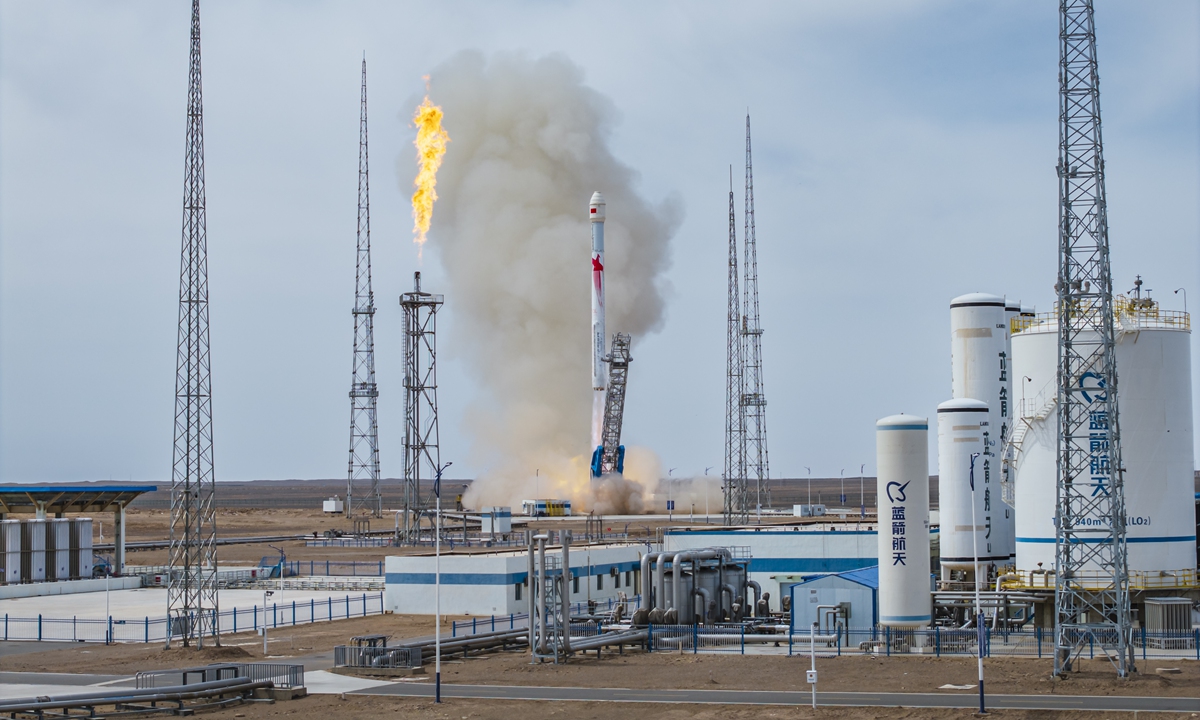
LandSpace's Zhuque-2E Y5 launch was a complete success, carrying a 2.8-ton experimental payload to a 900-kilometer orbit and marking a step toward large-scale liquid oxygen-methane rocket application. The mission highlights improved heavy-payload capability, with the rocket featuring four TQ-12A first-stage engines at 828 kN each and a TQ-15A second stage at 858 kN vacuum thrust. While strategically important for China's commercial space sector, the news is largely company- and industry-specific rather than market-moving.
This is less a one-off launch headline than evidence that China’s commercial launch market is moving from prototype economics to industrial throughput. The key second-order effect is pricing pressure: once a domestic provider can credibly lift heavier payloads on repeatable liquid-methane systems, the differentiator shifts from “can you launch?” to cadence, unit cost, and integration reliability. That tends to compress margins for smaller launch startups while expanding the addressable market for satellite builders, bus integrators, and ground-segment vendors that can now plan around more frequent domestic access to orbit. The most interesting signal is the step change in payload class, not the launch itself. Larger-mass missions usually pull forward demand for constellation operators, remote sensing firms, and government-linked payload programs that have been waiting on a lower-cost/heavier-lift domestic option; that can create a 6-18 month demand reacceleration in upstream components such as valves, avionics, precision machining, cryogenic materials, and range services. Conversely, reusability remains the gating issue: if booster recovery continues to underperform, the cost curve will improve slower than the market is likely assuming, which keeps this sector vulnerable to disappointment after the initial celebration fades. The contrarian view is that investors may be over-indexing on headline payload capability and underestimating manufacturing complexity. Methane systems are cleaner, but they are not automatically cheaper at scale if recovery hardware, testing cadence, and quality control remain immature; a single anomaly can reset customer confidence for multiple quarters. In other words, the near-term winner is probably the supply chain, while the long-term winner depends on whether the next 2-3 flights prove that higher thrust is translating into durable launch economics rather than just better demonstrations.
AI-powered research, real-time alerts, and portfolio analytics for institutional investors.
Request DemoOverall Sentiment
moderately positive
Sentiment Score
0.48
