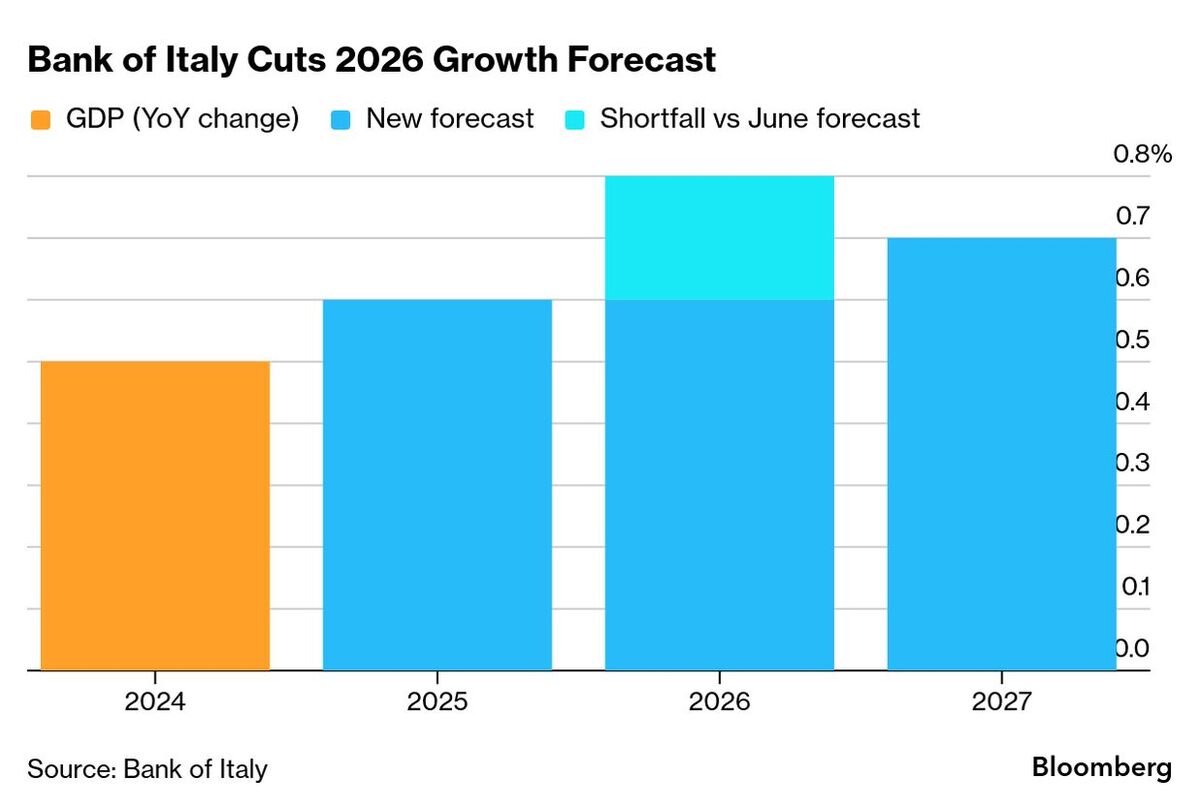
The Bank of Italy has lowered its 2026 GDP growth forecast for the euro zone's third-largest economy to 0.6% from a previous 0.8%, attributing the revision to global trade tensions that are negatively impacting exports. While maintaining its 2024 projection at 0.6% (exceeding the government's estimate), the central bank's updated outlook highlights persistent external headwinds for Italy's economic performance.
The Bank of Italy has revised its Gross Domestic Product (GDP) growth forecast for 2026 downward to 0.6% from a prior projection of 0.8%. This adjustment reflects increasing concerns over global trade tensions, which are expected to significantly weigh on the nation's export performance.
As the euro zone's third-largest economy, Italy's decelerating growth outlook, driven by external trade headwinds, signals potential broader economic challenges for the region. The central bank explicitly cited global trade tensions as the primary factor behind the reduced forecast.
While the 2026 outlook is tempered, the Bank of Italy maintained its 2024 growth projection at 0.6%, which remains above the government's 0.5% estimate, and anticipates 0.7% growth for 2027. Despite these near-term consistencies, the overall tone of the updated projections is pessimistic, reflecting a moderately negative sentiment regarding future economic momentum.
AI-powered research, real-time alerts, and portfolio analytics for institutional investors.
Request DemoOverall Sentiment
moderately negative
Sentiment Score
-0.40
