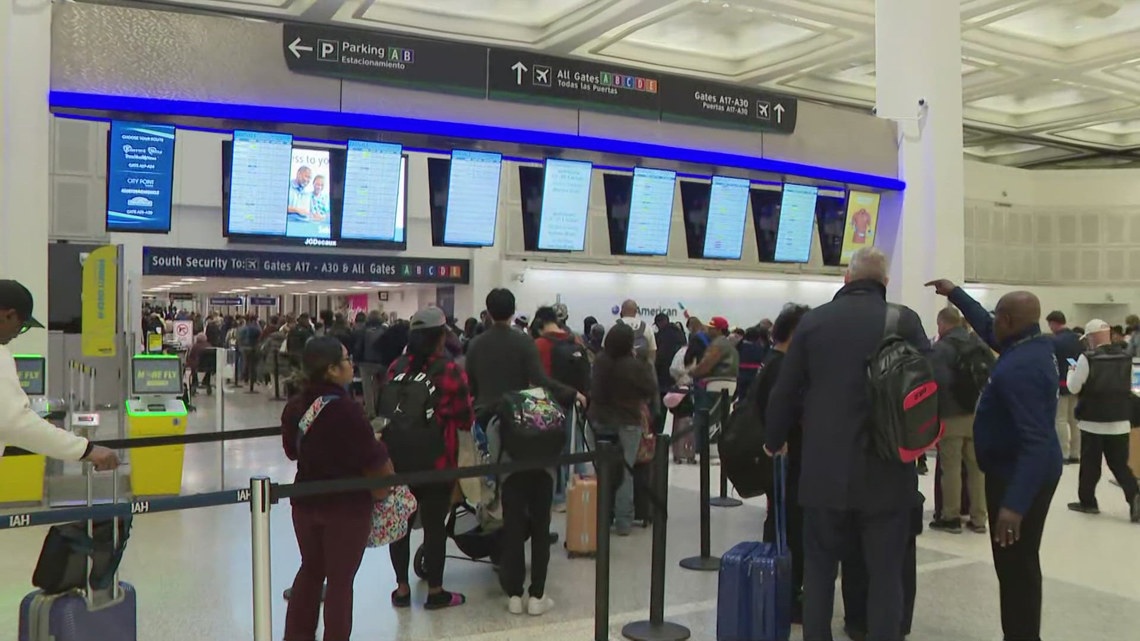
Expect security wait times of up to four hours or more at Houston Bush Intercontinental (IAH) on Mar 26 as a partial federal shutdown has thinned TSA staffing and passenger volumes surge due to CERAWeek and the NCAA tournament. Operational changes include TSA staffing limited to Terminals A and E, temporary suspension of TSA PreCheck and CLEAR, and a requirement for Terminal D departures to check bags at D then proceed to Terminal E for screening. A small contingent of TSA National Deployment Officers has been deployed to open additional lanes and Houston Airports is publishing live wait-time updates on a centralized webpage.
Operational friction from intermittent federal staffing shortages behaves like a stochastic capacity shock: throughput drops unpredictably shift delay risk from a deterministic schedule problem to a volatility problem that cascades through aircraft rotations, crew legality windows and gate utilization. That volatility is disproportionately costly to network carriers — a handful of delayed widebody rotations can force suboptimal re-routes and overnighting that inflate operating costs by thousands per aircraft-day and depress available seat miles for multiple days.
Hidden winners are the non-airline touchpoints that capture displaced demand and captive spend: ground-transport providers, airport hotels and parking/concession operators see utilization and yield improvements in short windows, and staffing/surface-ops vendors pick up overtime and temporary deployment revenue. Conversely, big-brand carriers suffer a higher marginal cost of customer recovery (rebook/reaccommodation, lost loyalty) that can compress ancillary margin and raise customer-acquisition costs if the operational pain is repeated across markets.
The path-dependency is binary and fast: a near-term political fix or overtime funding clears the shock within days and collapses any premium; a protracted impasse (weeks→months) forces corporate travel policy changes and could produce a sticky 1–3% structural demand hit to business travel over 12 months. Watch for three catalysts that would flip the view quickly: (1) federal funding patch or emergency staffing draws down volatility, (2) major event cancellations or corporate travel advisories that institutionalize lower travel, and (3) accelerated investment announcements in automation/security tech that shift capital to equipment vendors rather than incumbents handling throughput manually.
AI-powered research, real-time alerts, and portfolio analytics for institutional investors.
Request DemoOverall Sentiment
mildly negative
Sentiment Score
-0.25
