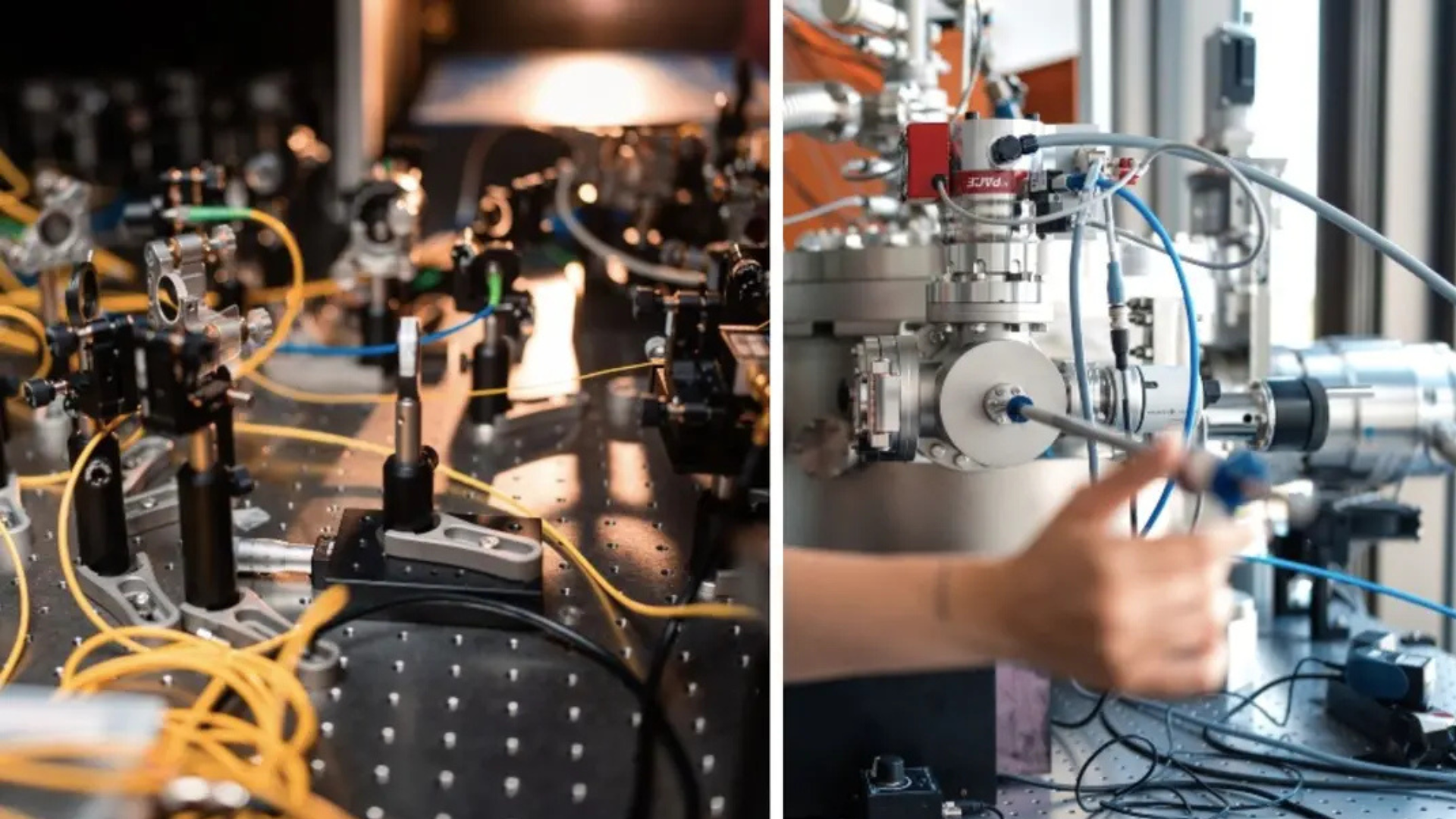
Researchers at the University of Stuttgart report discovery of a higher-order “super‑moiré” magnetic state in twisted double‑bilayer chromium triiodide, imaged via scanning nitrogen‑vacancy magnetometry and published in Nature Nanotechnology. The team observed ordered dot‑like textures spanning multiple moiré unit cells with individual features ~60 nm and overall texture sizes up to ~300 nm around a ~1.1° twist (vanishing near ~2°), attributed to competing exchange, anisotropy and interfacial Dzyaloshinskii‑Moriya interactions. The finding suggests twist angle can tune antiferromagnetic skyrmion-like states potentially useful for ultra‑dense magnetic data storage and spintronics, but experiments were at cryogenic temperatures on an air‑sensitive material, so commercial impact is speculative and contingent on transfer to more robust, higher‑Tc materials.
Market Structure: This discovery primarily benefits suppliers of advanced R&D tools, nanoscale imaging, and fabrication equipment (semiconductor equipment names like AMAT, LRCX, ASML and scientific-instrument vendors such as BRKR) because commercialization requires precision stacking, twist-angle control and advanced metrology. Legacy magnetic-storage incumbents (WDC, STX) face theoretical long-term risk to density leadership, but practical impact is likely >3–7 years given cryogenic/air‑stability barriers. Pricing power shifts toward firms owning IP, process know‑how and specialty materials rather than commodity HDD makers.
Risk Assessment: High-probability near-term risks include irreproducibility, the need for cryogenic operation and material air-sensitivity; low-probability tail risks include a rapid breakthrough (room-temperature, air-stable material) that forces accelerated capex. Hidden dependencies: scalable twist-angle control, spin-orbit heavy-element integration, and CMOS integration pathways—each could add 12–36 months to commercialization. Key catalysts to watch in the next 6–24 months: room‑temp demos, replication by independent labs, and large‑cap partnerships or IP transfers to Samsung/Micron/Intel.
Trade Implications: Tactical asymmetric longs in equipment/instrumentation are preferred over direct memory/HDD bets. Use 6–24 month LEAP call exposure on AMAT (0.75–1.5% NAV) and BRKR (0.5–1% NAV) via call spreads to limit premium; initiate a micro pair trade long AMAT (1%) / short WDC (0.25%) to express structural divergence. Allocate 1–2% of venture/Opportunistic capital to private materials spintronics funds or startups if pre-money valuations imply >5x upside on a breakthrough within 3–5 years.
Contrarian Angles: The market will likely underweight the multi-year tooling/IP monetization path and overestimate near-term HDD disruption—do not short HDDs aggressively; instead capture alpha from equipment makers and small-cap instrument names that historically re-rate with sustained R&D cycles. Historical parallel: early graphene/moiré hype created long lead times to commercialization; flip to short volatility (sell puts) only after confirmation of repeatable room‑temperature demos or large-scale fab commitments within 12 months.
AI-powered research, real-time alerts, and portfolio analytics for institutional investors.
Request DemoOverall Sentiment
mildly positive
Sentiment Score
0.25
