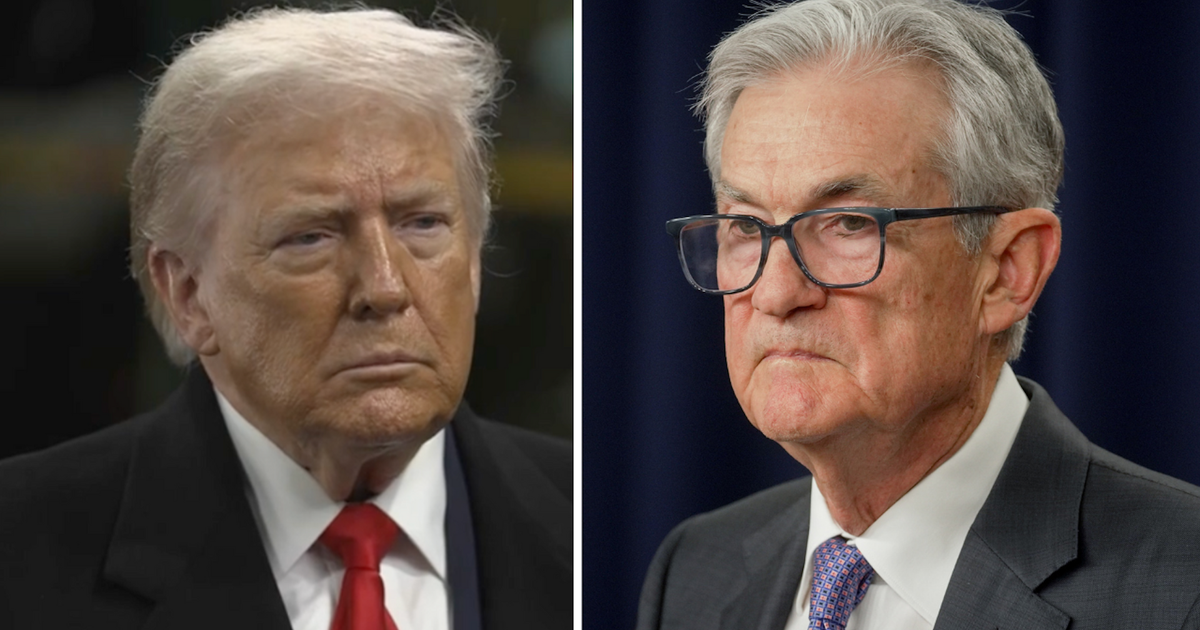
Former President Trump sharply criticized Fed Chair Jerome Powell as "a lousy Fed chairman" and accused him of corruption or incompetence amid a DOJ grand jury subpoena probing a $2.5 billion renovation of Federal Reserve office buildings (up from a prior $1.9 billion estimate). Powell says the probe follows his resistance to political pressure to cut the benchmark rate; three former Fed chairs publicly defended Powell, raising the stakes around central-bank independence and potential policy uncertainty that could feed volatility in interest-rate-sensitive markets.
Market structure: Political attacks on the Fed and a DOJ probe increase policy uncertainty and raise the odds markets price for easier Fed policy; a 25–50bp easing priced into the next 3–6 months would favor long-duration assets (TLT, long-term REITs) and gold (GLD) while compressing banks’ NIMs (KRE, XLF). Credit-sensitive sectors and small-cap regional banks are the most direct losers; rate-sensitive growth and utilities are the primary beneficiaries if markets materially reprice cuts. Cross-asset: expect downward pressure on US yields if cuts look likelier (10y could trade 10–30bps lower near-term), higher implied volatility in rates and equities, modest dollar weakening, and upside in gold and commodity inflation hedges.
Risk assessment: Tail scenarios include a sustained politicization of the Fed leading to policy paralysis or a leadership vacuum — this could trigger >50bp intraday swings in 10y yields and sharp equity volatility. Time horizons split: immediate (0–7 days) headline-driven moves, short-term (1–3 months) where positioning and CPI/PCE prints matter, and long-term (6–24 months) where institutional norms and election outcomes decide structural risk. Hidden dependencies: bank earnings sensitivity to rapid rate moves, margin compression from cuts, and FX reserve flows if confidence in US policy weakens. Catalysts: DOJ filings, Fed minutes/transcripts, monthly CPI/PCE, and any administration statements; each can move markets materially within 24–72 hours.
Trade implications: Tactical direct play is a hedged duration exposure: establish 2–3% NAV long in TLT for 3–6 months, paired with a 2–3% short in KRE (or XLF) to express NIM downside; exit if 10y yield rises >30bps or KRE outperforms XLF by >5% in 2 weeks. Options: buy 3-month GLD call spread sized to 1–2% NAV (5%–8% upside breakeven) to capture safe‑haven upside and buy 3-month 10–15% OTM puts on KRE as insurance. Sector rotation: overweight Technology (QQQ) and Utilities (XLU) by +2–4% net, underweight Financials (XLF/KRE) by -3–5% until clarity returns.
Contrarian angles: Consensus assumes headline moves are transient; historically Fed-target threats rarely change long-term policy — a snapback rally in banks is possible if Powell retains broad institutional support (as signaled by ex‑Fed chiefs). Mispricings: regional banks often overshoot on political headlines — consider one-way short caps at 2–3% with tight stop-loss (6–8%) rather than large directional bets. Unintended consequences: if political pressure forces cuts, short banks can lose (loan volumes and asset prices may improve), so size positions small and timebox them to 3 months pending DOJ/Fed developments.
AI-powered research, real-time alerts, and portfolio analytics for institutional investors.
Request DemoOverall Sentiment
moderately negative
Sentiment Score
-0.30
