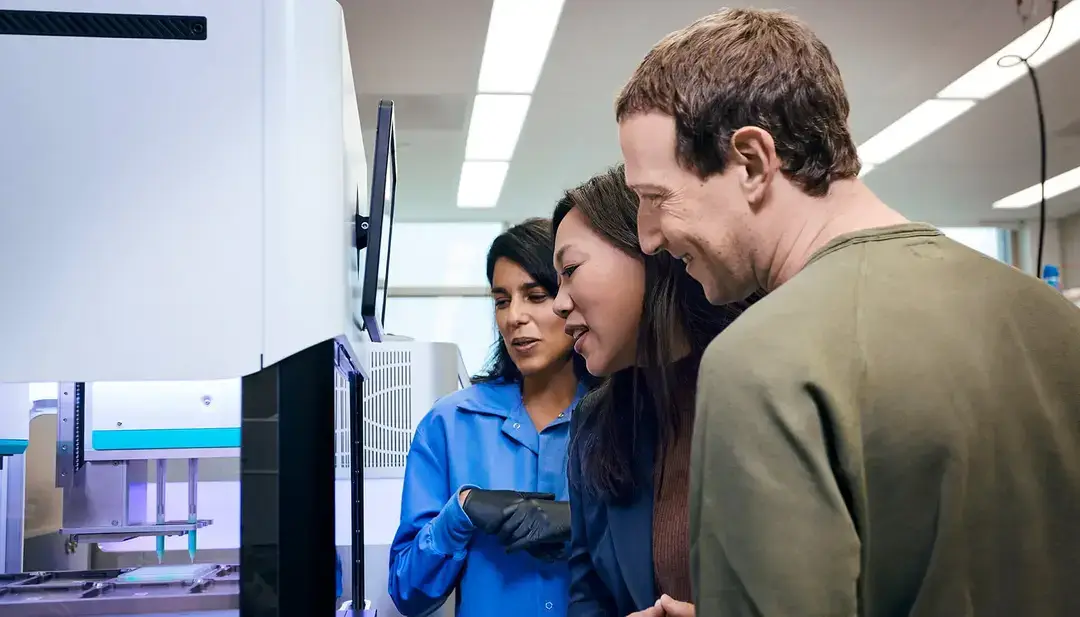
Mark Zuckerberg announced a $500 million, five-year initiative with Priscilla Chan to use AI to build digital models of human cells and simulate cellular behavior. The project targets biological research and virtual experimentation, reinforcing the intersection of AI and healthcare innovation. The announcement is strategically positive for the involved ecosystem, but it is unlikely to have an immediate material market impact.
This is less a near-term catalyst than a capability-shaping spend that could widen the moat for whoever controls the best biological data pipelines, model training infrastructure, and wet-lab validation loop. The first beneficiaries are likely to be hyperscalers, GPU/accelerator vendors, and software layers that can translate messy biological data into standardized model inputs; the economic value accrues not from the research announcement itself but from the long-duration procurement and talent pull it creates. In healthcare, the highest-quality private platform companies in single-cell analysis, lab automation, and AI-enabled drug discovery should see easier fundraising and richer strategic optionality as this legitimizes virtual biology as a budget line item. The less obvious second-order effect is competitive pressure on incumbent biotech CROs and early-stage discovery shops that monetize trial-and-error experimentation. If digital cell models improve even modestly, the winner-take-most dynamic shifts upstream: fewer wet-lab iterations, faster candidate triage, and lower cost of failed experiments. That compresses demand for some outsourced discovery spend over a 2-5 year horizon, while increasing demand for compute, data curation, assay validation, and regulated model provenance tools. The main risk is timeline slippage. Biological simulation is prone to hype cycles: if early outputs look impressive in demos but fail to generalize across cell types, investors may discount the initiative as a long-dated research grant rather than a commercial platform. A reversal would likely come from negative reproducibility signals, regulatory skepticism around AI-generated biological insights, or a broader AI-capex rotation that penalizes speculative life-sciences projects before revenue is visible. Consensus may be underestimating how capital-efficient this could be for private biotech: even a small reduction in failed preclinical programs materially lifts returns on R&D, which could re-rate a handful of enabling platforms well before any therapeutic breakthrough. The better trade is not to chase headline AI-healthcare beta, but to own the picks-and-shovels where budgets are already migrating and downside is capped by diversified demand.
AI-powered research, real-time alerts, and portfolio analytics for institutional investors.
Request DemoOverall Sentiment
moderately positive
Sentiment Score
0.45
