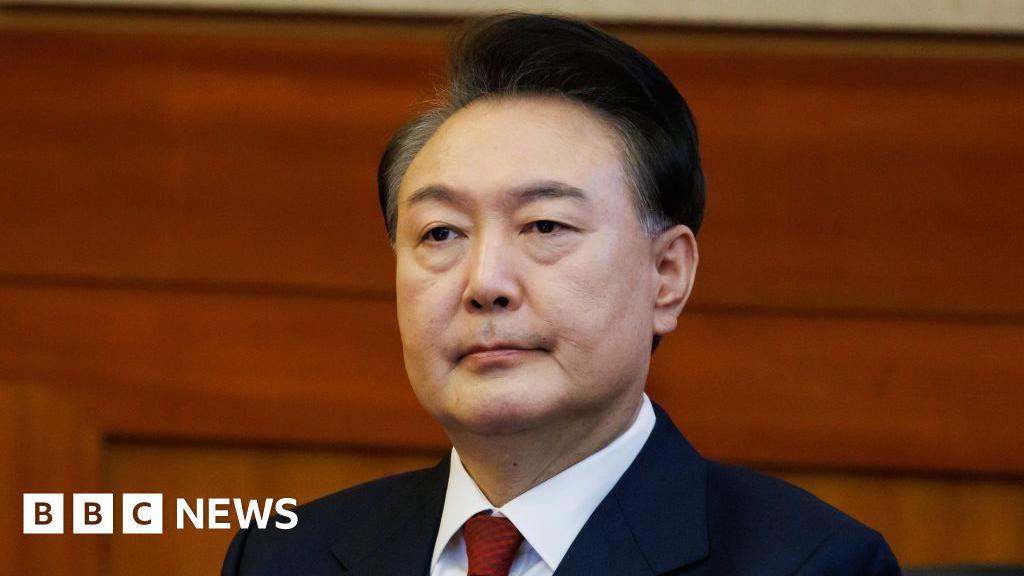
South Korea's impeached ex-president Yoon Suk Yeol was found guilty of abuse of power, falsifying documents and obstruction of justice over his failed 2024 martial law attempt and was sentenced to five years in prison; he faces three additional trials including an insurrection case for which prosecutors have sought the death penalty. Prosecutors also allege he tried to provoke North Korea and charged him with aiding an enemy state, with senior security officials also indicted. The convictions deepen political instability and constitutional uncertainty in Seoul, creating a risk-off backdrop that could spur short-term volatility in Korean assets and heighten geopolitical risk premia in the region.
Market structure: The verdict raises immediate political-risk premia for Korean assets. Expect KOSPI/EWY to underperform global peers near-term (3–7% downside within days–weeks) and USD/KRW to move +2–5% as non-resident flows exit; exporters (auto/ships/commodities) may see mixed effects from FX-driven earnings gains while domestic cyclicals, banks and consumer names face pressure. Defense and global capital equipment suppliers (ASML, LRCX) are relative winners on a geopolitical-risk repricing.
Risk assessment: Tail risks include widescale unrest, temporary capital controls, or a North Korean provocation that disrupts supply chains — low probability but high impact (20–40% idiosyncratic drawdowns in Korean domestic names). Timeline: immediate volatility spike (days), legal/court cadence driving sentiment over 3–12 months, and a likely political normalization/pardon script within 12–24 months that would reverse some sell-side flows. Hidden dependencies: Korean bank funding via non-resident short-term FX positions and chip-industry capex cycles amplify second-order effects.
Trade implications: Tactical plays should hedge equity exposure and buy protection: short EWY or KOSPI futures sized 2–3% of portfolio for 0–90 days; go long USD/KRW via forwards/NDF (1–2% NAV) with a profit target of +5% or stop at -1.5%. Use options: buy 1–3 month KOSPI put spreads to cap cost, and consider 3–12 month puts on 005930.KS/000660.KS as portfolio insurance; overweight defense/secure supply-chain names by 1–2% on draws.
Contrarian angles: The market may overprice permanent damage; historical parallels (Chun/Roh) suggest sentences can be symbolic and followed by pardons within 1–2 years, creating a mean-reversion rally of +20–40% in deeply sold Korean large caps. If KOSPI falls >10% and 5y Korea CDS tightens back toward +50bp from current wides, start phased buys of core semiconductor names (005930.KS, 000660.KS) on 6–12 month horizon — risk is a protracted political stalemate that delays capex and earnings recovery.
AI-powered research, real-time alerts, and portfolio analytics for institutional investors.
Request DemoOverall Sentiment
moderately negative
Sentiment Score
-0.50
