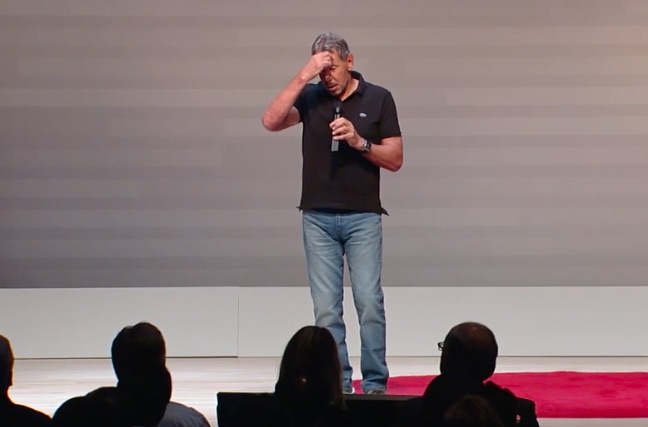
Oracle laid off thousands of employees as it reallocates spending to AI datacenter buildout; rumored cuts could reach 30,000 (≈18% of ~162,000 headcount). The company noted a $1.6B restructuring plan for the fiscal year and expects roughly $50B in capital expenditures for fiscal 2026, while partnering with OpenAI and SoftBank on the Stargate datacenter project. Near-term impact: significant headcount reductions and restructuring charges may pressure operating metrics and increase execution risk on a large capex program, though datacenter investments target higher-margin (30–40%) revenue-generating equipment.
Shifting a legacy enterprise-software business toward capital-intensive AI hosting materially changes the finance mix: higher depreciation and utilization sensitivity make free cash flow lumpy and push valuation toward an infrastructure multiple rather than a pure software multiple. If utilization misses plan by even a few percentage points, ROI on incremental racks falls sharply because the majority of returns are derived from tight capacity economics rather than recurring license renewals. Expect near-term margin normalization pressure as one-time restructuring saves cash but removes margin-accretive recurring revenue growth vectors.
Talent and security gaps from rapid workforce reallocation are an underappreciated operational risk. Loss of institutional product and sales knowledge will slow go-to-market and upsell velocity for 12–24 months, creating an opening for competitors and channel partners to accelerate share gains. Concurrently, any reduction in mature security engineering depth raises both breach risk and compliance remediation costs — a tail event that can drive material churn among large enterprise customers, not just small accounts.
On the supplier side, the winners will be GPU, switch, and systems vendors whose order books are fungible across buyers; the losers are incumbent services and reseller channels that rely on predictable, high-touch enterprise sales. Credit metrics will be the immediate barometer — capex-driven asset growth plus a weaker revenue uplift will choke interest coverage and free cash flow conversion in the next 6–24 months. Catalysts to monitor that would reverse sentiment are visible utilization beats, a large non-core asset sale that meaningfully de-risks the balance sheet, or a rapid re-acceleration in enterprise renewals that proves the new model is additive rather than substitutive.
AI-powered research, real-time alerts, and portfolio analytics for institutional investors.
Request DemoOverall Sentiment
strongly negative
Sentiment Score
-0.60
Ticker Sentiment
