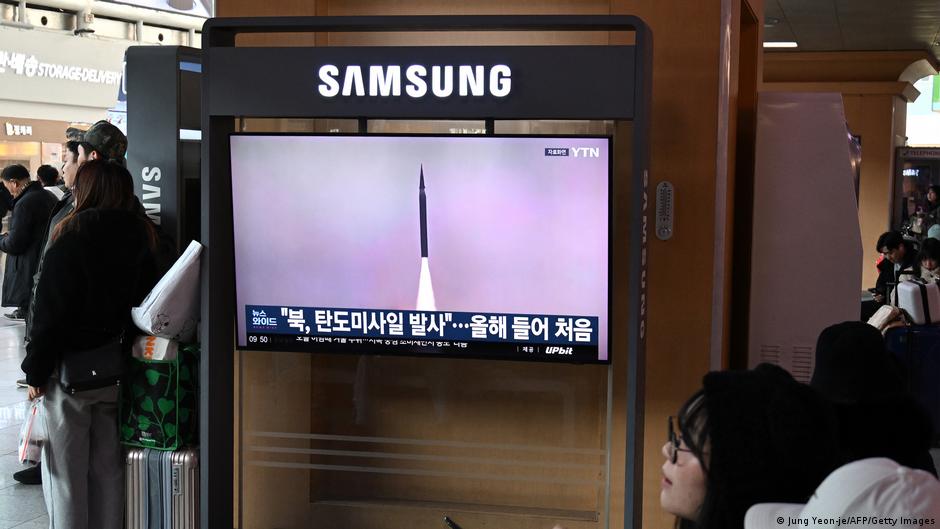
North Korea fired multiple ballistic missiles from the Wonsan area toward eastern waters on Apr 8, 2026, following an unidentified projectile on Apr 7 that may have been a failed missile. The launches and Pyongyang's explicit rejection of rapprochement raise regional geopolitical risk, likely triggering short-term risk-off flows into safe havens (gold, JPY, US Treasuries), increased volatility for Korean equities, and potential uplift for defense-related stocks.
Heightened military signaling on the peninsula is reintroducing a classic risk-off impulse that tends to compress regional beta and widen cross-border funding spreads; expect a knee-jerk KRW selloff and KOSPI underperformance in the 3–10 day window as offshore managers de-lever. Empirically, similar episodes since 2010 produced 4–8% KRW weakness and 5–12% KOSPI drawdowns within the first two weeks, with most of the move realized inside five trading days before headline-driven mean reversion.
Defense-capex and FMS call options become second-order winners: procurement timelines accelerate only after political signaling crosses a threshold (public commitments, joint drills, or US-South Korea arms announcements), which typically lands in the 3–12 month window — this creates a convex payoff for defense names with export backlogs. Conversely, local cyclicals tied to discretionary capex and autos (large domestic banks, non-essential retail) are most exposed to a multi-week risk-off and higher swap/credit spreads.
Market mechanics to watch: (1) front-end US rates and JPY flows — a sharp Treasury rally + JPY safe-haven inflow will amplify EM FX stress; (2) insurance/reinsurance pricing and shipping rerouting risk for Northeast Asia manufacturing hubs — premiums and lead times reprice within 1–3 months if volatility persists; (3) diplomatic de-escalation signals from Beijing or a US-South Korea joint communiqué could erase >50% of the initial move within 2–6 weeks. Position sizing should treat the current phase as tactical (days–weeks) for most liquid hedges and strategic (3–12 months) for defense/insurance allocations.
AI-powered research, real-time alerts, and portfolio analytics for institutional investors.
Request DemoOverall Sentiment
strongly negative
Sentiment Score
-0.60
