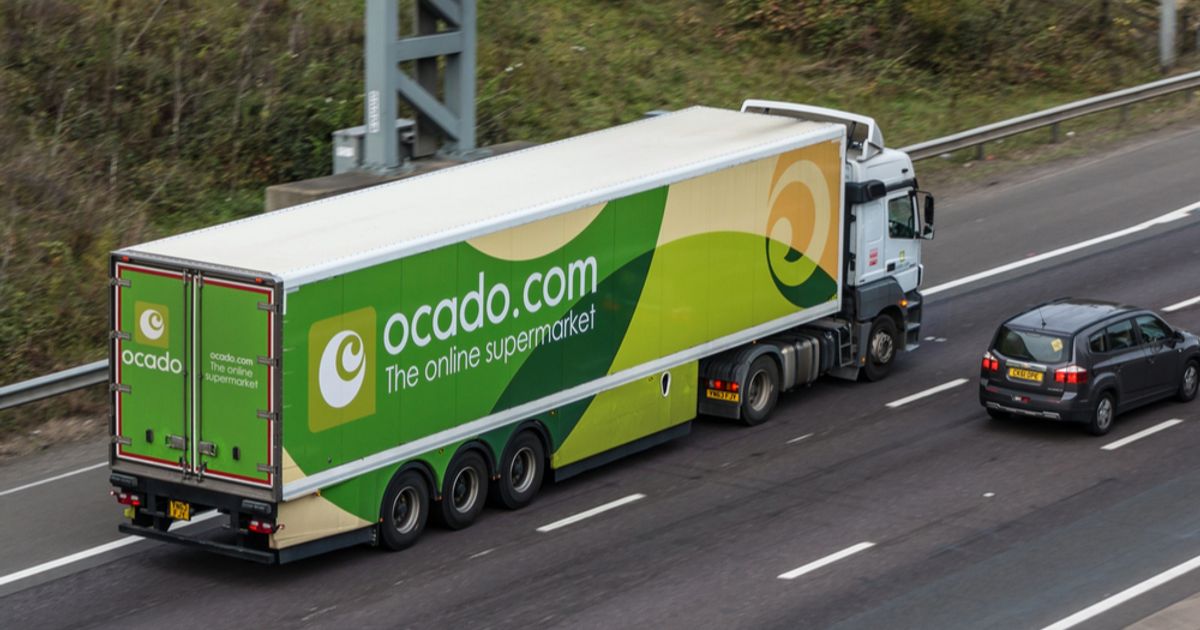
JP Morgan placed Ocado on a Positive Catalyst Watch ahead of results due 26 February, citing improving trading conditions, clearer visibility on the Kroger partnership (continuation at six sites) and a stronger balance sheet after repayment of 2025/2026 maturities and a reported £260m termination fee from Kroger. The bank expects management to prioritise cost optimisation and margin expansion, forecasting Core Tech Solutions EBITDA margins rising from 25% in 2025 to 40% by 2027 and targeting free cash flow break‑even for the year by 2027; its November 2027 price target remains 290p, noting the target implies further module reductions (37) which it deems unlikely.
Market structure: Positive JPM coverage and the Kroger termination fee materially reprice Ocado’s near-term liquidity and optionality—direct winners are OCDO equity, Ocado’s Core Tech customers (vendors benefiting from stronger credit), and suppliers of automation modules who avoid near-term write-downs. Losers include large incumbent US grocers (KR) facing restructuring costs and module closures; fewer active modules temporarily reduce capital spending demand, pressuring module suppliers but improving supply-side pricing power for remaining high-quality automation providers. Cross-asset: expect narrowing OCDO bond spreads and lower equity implied volatility if guidance is constructive; GBP could tick up on a clean print, while commodities unaffected.
Risk assessment: Tail risks include failed commercial renewals (loss of >1 major partner), execution problems at existing automation sites, or a broader US grocery capex pullback which could erase JPM’s 40% EBITDA-margin path; probability medium but impact >50% equity downside. Timing: immediate (days) — elevated pre-earnings volatility; short-term (weeks/months) — management commentary on Kroger, pipeline and cost cuts; long-term (2026–27) — margin expansion and FCF targeting depend on module utilisation and new deals. Hidden dependency: one-off £260m Kroger fee masks recurring revenue weakness; management’s FCF guidance is modular-count sensitive. Catalysts: Feb 26 results, Kroger partner updates, and new US contract wins/losses.
Trade implications: Direct play — selective long OCDO exposure to capture re-rating toward JPM’s 290p Nov-2027 target, but size to 2–3% of portfolio with stop at -20% pre-earnings; prefer defined-risk option structures (buy-to-open call spreads expiring June 2026) to capture upside while limiting premium. Pair trade — long OCDO vs short KR (equal notional 1:1, small size 1% each) to isolate technology optionality vs grocery operator risk through H1 2026. Sector rotation — reduce generic grocery retailer exposure and reallocate 2–4% into European retail tech/software names where balance-sheet-led de-risking can produce similar multiple expansion.
Contrarian angles: Consensus leans positive on margin recovery; what’s missed is dependency on module count — JPM’s 40% EBITDA target assumes sustained sales and limited further closures (JPM even assumes fewer than 37 additional module cuts). The termination fee is one-off and may have already priced a large part of near-term upside; if Feb 26 guidance lacks a multi-customer pipeline or reiterates exclusivity losses, downside is sharp. Historical parallel: automation vendors (e.g., early robotics rollouts) saw fast sentiment reversals when marquee partners scaled back; position sizing must reflect that asymmetric risk.
AI-powered research, real-time alerts, and portfolio analytics for institutional investors.
Request DemoOverall Sentiment
mildly positive
Sentiment Score
0.35
Ticker Sentiment
