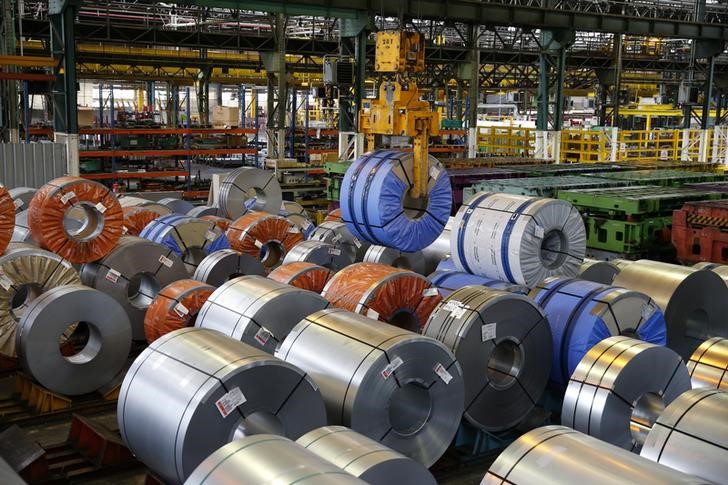
Airstrikes hit Mobarakeh and Khuzestan, disrupting output at two of Iran’s largest steel plants that together account for <20% of national capacity; Iran’s utilization was already <50% so domestic production could be reallocated. Roughly 65% of GCC steel capacity faces Hormuz-related import constraints, while China supplies >60% of GCC steel imports, implying the region will lean on Chinese finished steel and push demand for iron ore and hard coking coal. Barclays flags a likely 'war-risk' premium on IO and HCC prices sustained through Q2 2026, creating sector-level volatility but limited immediate global supply disruption.
The market reaction to localized strikes will manifest less as a one-off supply shock and more as a persistent risk-premium in seaborne raw-material logistics: insurance, vessel re-routing, and HAM (time-charter) spreads are the lever that turns regional disruption into global price action for iron ore and coking coal. That transmission is non-linear — a 10% uplift in freight/insurance can translate into a near-term 3–7% increase in landed ore costs at Asian blast furnaces, forcing marginal miners to ramp and tightening seaborne availability within 2–3 months.
Second-order winners are large, low-cost seaborne iron-ore producers with flexible port logistics and existing long-term offtakes, because they can capture both volume and a rising price/margin mix while smaller domestic mills remain constrained by raw-material logistics. Conversely, integrated steelmakers that depend on short-cycle inland scrap flows or Gulf-imported concentrates face margin squeeze from higher landed raw materials and elevated working-capital needs as LC/FX hedging activity increases.
Key catalysts and reversal points are political (credible de-escalation or explicit shipping-lane security guarantees) and macro (China stimulus or a deep manufacturing slump). Expect the war-risk premium to be most visible in freight and spot IO/HCC curves over the next 3–9 months; if China reopens aggressive infrastructure stimulus, the premium amplifies, but if China steel demand falls >5% YoY the whole chain re-prices lower within 1–2 quarters.
AI-powered research, real-time alerts, and portfolio analytics for institutional investors.
Overall Sentiment
mildly negative
Sentiment Score
-0.25
Ticker Sentiment
