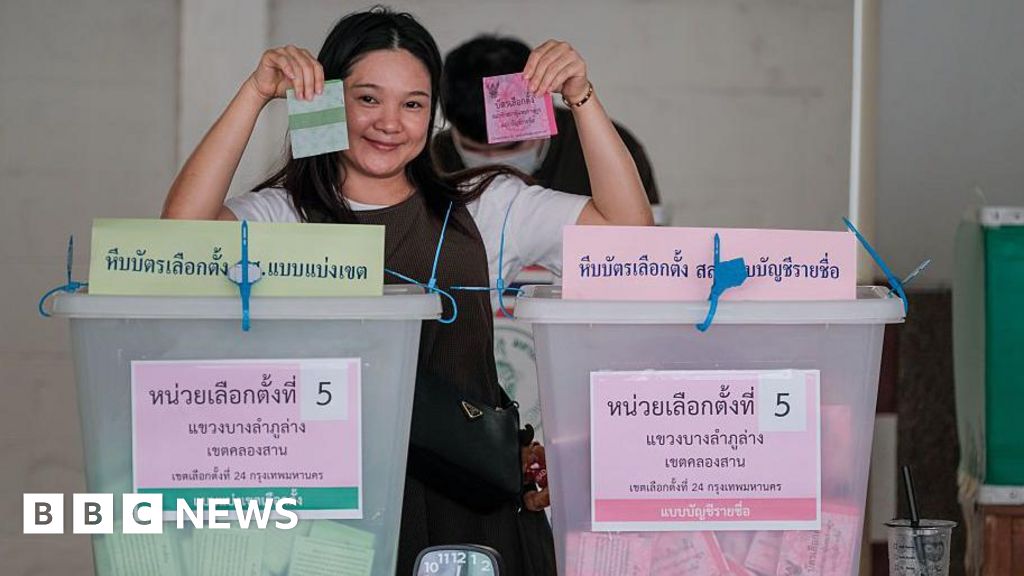
Thailand held an early election pitting the reformist People's Party against conservative forces led by Bhumjaithai's Anutin Charnavirakul, with results expected late evening and no party likely to secure an outright majority. Political instability — three prime ministers in three years, past court dissolutions of reformist parties and a concurrent referendum on reforming the military-era 2017 constitution — has weighed on growth and foreign investor confidence; the People's Party won 151 seats in 2023 as a benchmark and may be blocked from power if unelected institutions intervene. Campaign promises from conservatives and Pheu Thai include subsidies and cash handouts, while reformers propose sweeping changes to business and military power, leaving substantial policy and execution risk for investors and prospects of capital/production relocation to regional peers.
Market structure: A People's Party win (especially >151 seats) is a clear negative for large family-controlled conglomerates and consumer subsidy beneficiaries (CPALL.BK, PTT.BK, AOT.BK) as regulatory/anti-monopoly talk rises; banks and export-oriented manufacturers face mixed effects depending on capital flows. Conservative/Bhumjaithai continuity favors infrastructure, tourism and domestic consumption plays (AOT.BK, travel names) and keeps policy predictable; supply-side risk is relocation of light manufacturing to Vietnam if investor confidence drops, implying export-oriented caps may see market-share gains for VNM-listed peers. Cross-asset mechanics: political shock likely to widen Thailand 10y-UST spreads by 20–80bps in stressed scenarios, push USD/THB higher by 2–8% and lift gold and regional safe-haven flows; options vol for THD (iShares MSCI Thailand ETF) and USD/THB should spike near results.
Risk assessment: Tail risks include constitutional court dissolution of a winning reform party (historical probability non-trivial) or a military intervention — both would produce >10% SET drawdowns and >5% THB moves intraday. Immediate (days) risk is headline-driven 3–7% moves in equities and FX; short-term (weeks) is sustained outflows (>$0.5–1bn) and underinvestment; long-term (quarters) is structural capital reallocation across ASEAN. Hidden dependencies: referendum outcome and judicial action timing are the critical triggers; catalysts include seat-counts crossing the 151 threshold, Thaksin legal developments, and foreign investor flow statements.
Trade implications: Tactical plays should use ETFs/FX/options for liquidity: buy 3-month USD/THB calls and THD puts if reformists clear 151 seats (target USD/THB +5%, THD -10%), or rotate into KBANK.BK and SCB.BK on a conservative outcome for a 3–6 month hold. Pair trade: long KBANK.BK (beta hedge 1–2% portfolio) / short CPALL.BK (equal notional) to express a pro-stability tilt versus anti-conglomerate risk. Reduce Thai sovereign duration now by 1–3 years and keep FX-hedged USD cash as a defensive leg while volatility resolves.
Contrarian angles: Consensus assumes immediate broad anti-business regulation if reformists lead, but courts have historically constrained radical change — if the People's Party wins but is blocked, volatility will spike then mean-revert, creating buy-the-dip opportunities in large exporters (PTT.BK) priced for permanent damage. Markets may overprice dissolution risk; selectively buying deeply oversold, high-export caps on >30% drawdowns (3–6 month recovery horizon) is a contrarian opportunity. Unintended consequence: capital flight could force a pragmatic, investor-friendly policy pivot by any new administration to stabilize FX and credit markets.
AI-powered research, real-time alerts, and portfolio analytics for institutional investors.
Request DemoOverall Sentiment
moderately negative
Sentiment Score
-0.50
