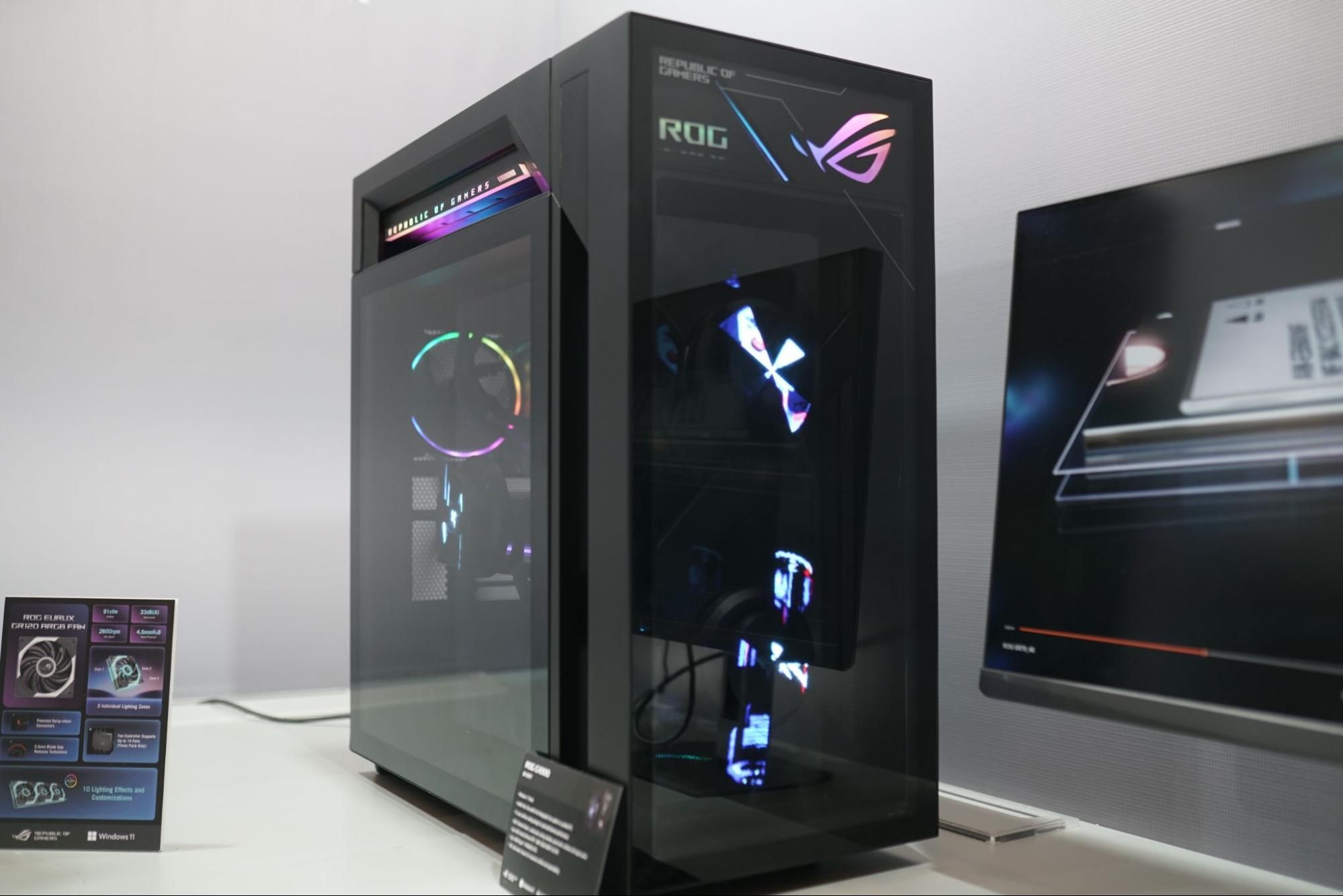
Asus unveiled the ROG G1000 flagship gaming desktop at CES, emphasizing ostentatious holographic lighting and high-end specs including up to an AMD Ryzen 9 9950X3D CPU, ROG Astral GeForce RTX 5090 (32GB GDDR7), 64GB DDR5-4800 (supports up to 128GB), a 2TB M.2 NVMe PCIe 4.0 SSD (support for up to 4TB PCIe 5.0), a 420 mm AIO cooler, 1,000W 80+ Gold PSU and Wi‑Fi 7. Asus has not disclosed pricing or availability, limiting immediate revenue or share-price implications; the release is notable primarily for product/brand positioning and potential to support premium ASPs in Asus’ gaming lineup if/when it reaches market.
Market structure: Asus’s ROG G1000 is a halo product that disproportionally benefits component suppliers (NVDA, AMD, DRAM/GDDR vendors) rather than OEMs — high-margin GPU (RTX 5090) and CPU (Ryzen 9 9950X3D) sales lift ASPs and channel profitability if volumes follow. Expect modest pricing power upside for Nvidia/AMD over the next 1–4 quarters if limited supply keeps build-to-order premiums (>5–15% over MSRP) intact.
Risk assessment: Key tail risks are supply disruptions (GDDR7 scarcity), a consumer discretionary pullback, or a sudden NVDA/AMD earnings/guide miss; any of these could compress multiples by 10–25% in 1–3 months. Hidden dependencies include channel inventory cycles and OEM discounting; watch distributor inventory days and GDDR7 wafer yields in the next 30–90 days as primary catalysts.
Trade implications: Tactical bias is long component makers (NVDA, AMD) and light/hedged exposure to OEMs (HPQ neutral-to-sold). Prefer options-defined exposure to cap risk: 3–6 month call spreads on NVDA/AMD to capture halo without paying full IV, and use pair trades (long NVDA vs short HPQ) to express positive mix shift to components.
Contrarian angles: The market may underprice that these builds are low-volume luxury — adoption must scale beyond CES demos to move fundamentals. If first reviews show thermal/driver issues or supply ramps quickly, sentiment could mean-revert; therefore favor capped-risk bullish structures and size positions modestly (1–3% of portfolio).
AI-powered research, real-time alerts, and portfolio analytics for institutional investors.
Overall Sentiment
neutral
Sentiment Score
0.15
Ticker Sentiment
