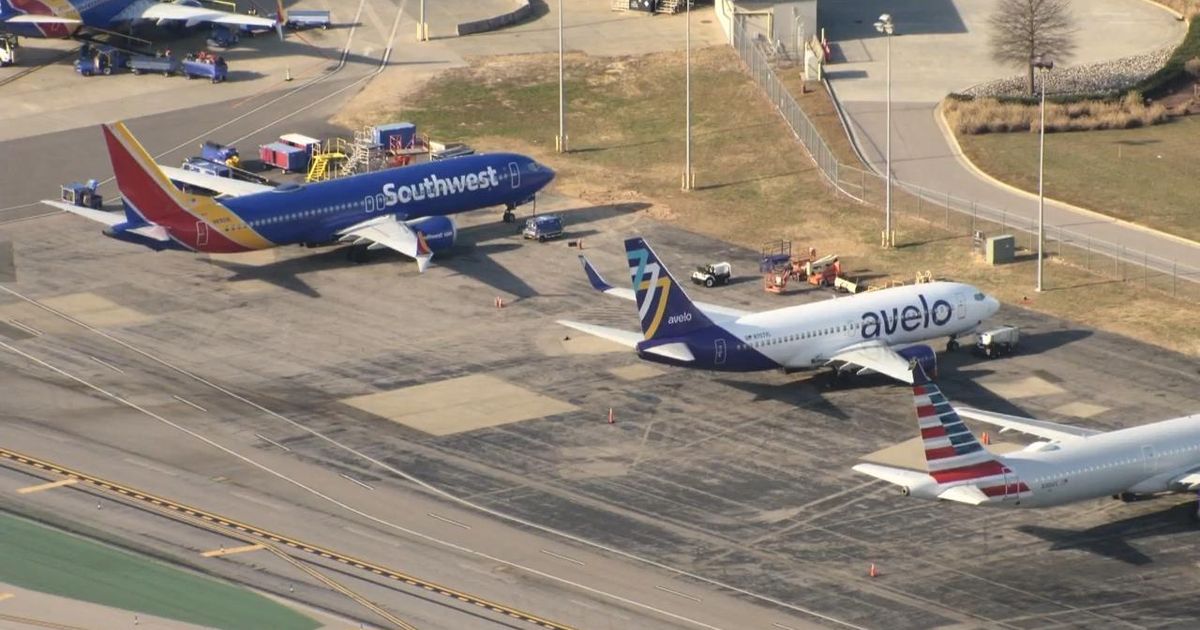
At Raleigh-Durham International Airport an Avelo aircraft being towed clipped the winglet of a parked Southwest Airlines plane; both aircraft were unoccupied and there were no injuries. RDU and Avelo reported airport operations were not affected and no flight delays or cancellations are expected, indicating minimal operational disruption and negligible near-term financial impact for the carriers.
Market structure: This incident is operationally trivial — no delays, no injuries — so direct winners are insurers/repair vendors (negligible) and losers are reputationally Avelo (private) and marginally LUV (Southwest) with a likely price impact under 1–2% intraday. Competitive dynamics unchanged; no capacity or pricing power shifts expected because both aircraft were parked and undisturbed. Cross-asset impact is immaterial to credit markets but can cause a 1–3 implied-volatility point bump in short-dated LUV options and a sub-5bp move in airline credit spreads if amplified by news cycles.
Risk assessment: Tail risks are low-probability/high-impact: a pattern of ground incidents could trigger FAA audits, fines >$10m or temporary towing/ground-handling restrictions causing 0.5–2% capacity loss in a hub over weeks. Immediate horizon (0–3 days) risk is social-media amplification; short-term (1–8 weeks) risk is an FAA/airport report that could lead to rule changes for towing contractors; long-term (quarters) consequences are minimal unless incidents cluster. Hidden dependency: outsourced ground-handling contracts and staffing levels at RDU — a single vendor with poor training can create cascading operational risk across multiple carriers.
Trade implications: Do not change core airline allocations on this single event, but prepare tactical plays: set buy-limit orders on LUV for a 1–2% contrarian re-entry if price weakness occurs within 1–5 trading days, targeting 3–5% mean reversion. For hedging, implement a 30-day collar on existing LUV positions (buy 2% OTM put, sell 5% OTM call) to cap downside at ~2% while financing premiums. Avoid taking directional positions in credit; watch short-dated IV and buy 30-day LUV puts (delta ~-0.25) only if IV <25% and price gap >2%.
Contrarian angles: Markets will likely underprice operational/ground-handling risk concentrated at secondary airports — opportunity if a genuine incident cluster emerges and smaller carriers reprice wider by >5%. Historical parallels (minor ramp collisions at regional airports) show 3–7 day mean reversion; downside overreaction is possible. Unintended consequence: insurers may reprioritize premiums for small carriers over 12–24 months, pressuring margins and creating selective long opportunities in well-capitalized carriers like LUV if spreads widen >50bps.
AI-powered research, real-time alerts, and portfolio analytics for institutional investors.
Request DemoOverall Sentiment
neutral
Sentiment Score
0.00
Ticker Sentiment
