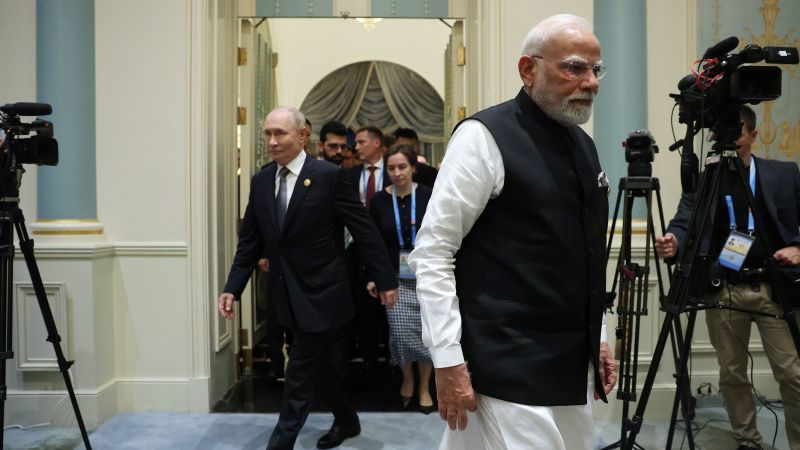
President Vladimir Putin’s visit to New Delhi underscores India’s strategic hedging between longtime defense and energy ties with Russia and expanding technology, trade and investment cooperation with the United States. Key near-term items include talks on potential Su-57 fighter purchases, India’s earlier surge and recent cutbacks in discounted Russian crude after Western sanctions, U.S. imposition of 50% tariffs on India (partly tied to Russian oil purchases), and New Delhi’s agreement to buy 2.2 million metric tons of U.S. LPG while negotiating a broader U.S. trade framework expected by year-end. The diplomatic balancing act preserves India’s bargaining leverage but increases scrutiny from Washington and introduces policy uncertainty for energy, defense suppliers, and trade-exposed sectors.
Market structure: India’s dual-track diplomacy props up domestic refiners (short‑term beneficiary of discounted Russian crude) and defence suppliers (HAL.NS, BEL.NS) while US exporters of technology and LPG gain leverage if a trade deal is concluded. If Washington sustains tariffs or secondary sanctions, India will import less Russian oil, tightening spot availability of discounted Urals and supporting Brent by +$5–$15/bbl in stressed scenarios over 3–6 months. FX and bond flows will be two-way: INR downside pressure on tariffs news (target test zone INR 82–86/USD) and higher 10y sovereign yields if capital outflows accelerate.
Risk assessment: Tail risks include US secondary sanctions on Indian banks handling Russian trade (low probability, high impact) and a major Russia‑Ukraine escalation that removes Russian barrels from markets (>$20/bbl shock). Immediate (days) moves will be headline‑driven; short term (weeks–months) depends on tariff negotiations and December import data; long term (quarters) on whether India formalises replacement supply chains with US/ME. Hidden dependencies: shipping insurance, swap/rupee‑settlement channels and India’s seasonal refinery turnaround calendar could abruptly change import volumes.
Trade implications: Tactical trades: buy 3–4 month Brent call spreads to hedge upside from renewed sanctions; buy 3–6 month USD/INR calls (or sell INR forwards) if INR >82.5 levels; establish a 2–3% long position in Reliance Industries (RIL.NS) and Indian Oil (IOC.NS) to capture potential refining margin expansion if discounted crude flows resume, size cut if December imports fall >25% y/y. Rotate into US LPG/LNG exporters (Enterprise Products EPD 1–2%, Cheniere LNG 1–2%) on a confirmed 2.2MT supply programme execution within 90 days.
Contrarian angles: Consensus assumes India will fully hedge to the US — it won’t. Markets may underprice India’s bargaining leverage; if tariff relief appears (60–120 days) Indian equities (INDA) could rerate +8–15% cyclical squeeze-out. Conversely, a secondary‑sanctions scare would be overdone initially — short‑dated volatility trades (buy 30–60 day straddles on INDA or USD/INR) offer asymmetric payoffs. Historical parallel: post‑sanctions run on discounted Russian crude in 2014 produced multi-month oil dislocations; position sizing must assume 20% drawdowns on proximate longs.
AI-powered research, real-time alerts, and portfolio analytics for institutional investors.
Request DemoOverall Sentiment
neutral
Sentiment Score
-0.15
