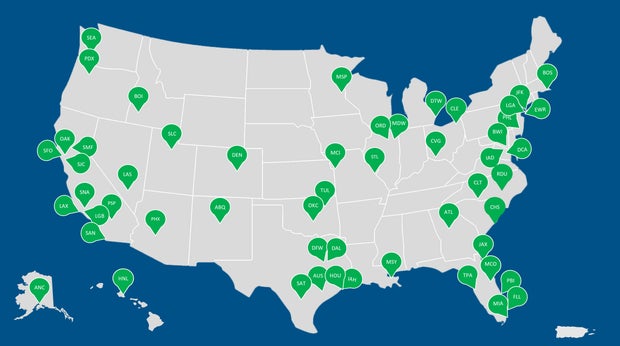
65 airports currently offer TSA PreCheck Touchless ID and five airlines (Alaska, American, Delta, Southwest, United) participate; travelers must already have TSA PreCheck, an active frequent-flyer profile with passport information, and a Known Traveler Number (KTN) to opt in. Enrollment is completed through each carrier's rewards account with small procedural differences, and some airlines also provide touchless bag-drop shortcuts; passengers should review airline privacy policies before enabling facial-scan identification.
Operationally, Touchless ID is a low-friction throughput lever: concentrated deployment at hub checkpoints and bag‑drops can raise lane throughput in peak periods by a single‑digit to low‑teens percent range, materially lowering missed‑connection rates for hub‑and‑spoke carriers and trimming gate turnaround variability. That incremental reliability compounds at scale — a 3–5% reduction in delay minutes at a major hub translates into higher aircraft utilisation and less short‑term swap/irregularity cost, which disproportionately benefits airlines with dense hub schedules and large corporate-travel mixes. On the demand side, ease of identity verification is a subtle loyalty accelerator for frequent flyers: carriers that embed opt‑in into their UX will earn disproportionate enrollment among high‑yield passengers, increasing loyalty program stickiness and ancillary take rates (faster bag‑drop = higher premium bag conversion). Conversely, third‑party biometric providers and airports that must retrofit bag‑drop kiosks face short‑term capex and integration risk; incumbents that move fastest capture the convenience premium, but also concentrate biometric datasets, raising counterparty and cyber exposure. Tail risks are clear and time‑staged: a major biometric data breach or an adverse regulatory ruling could trigger adoption reversals within weeks and produce equity drawdowns >20–30% for exposed carriers; political/regulatory scrutiny (Congress, state AGs) could impose consent or deletion requirements within 6–18 months, raising compliance costs. The contrarian angle is adoption friction — enrollment requires KTN/passport coupling and habitual behavior change, so meaningful P&L lift is unlikely to be front‑loaded; expect most measurable benefits to accrue over 6–24 months, not immediately.
AI-powered research, real-time alerts, and portfolio analytics for institutional investors.
Overall Sentiment
neutral
Sentiment Score
0.00
Ticker Sentiment
