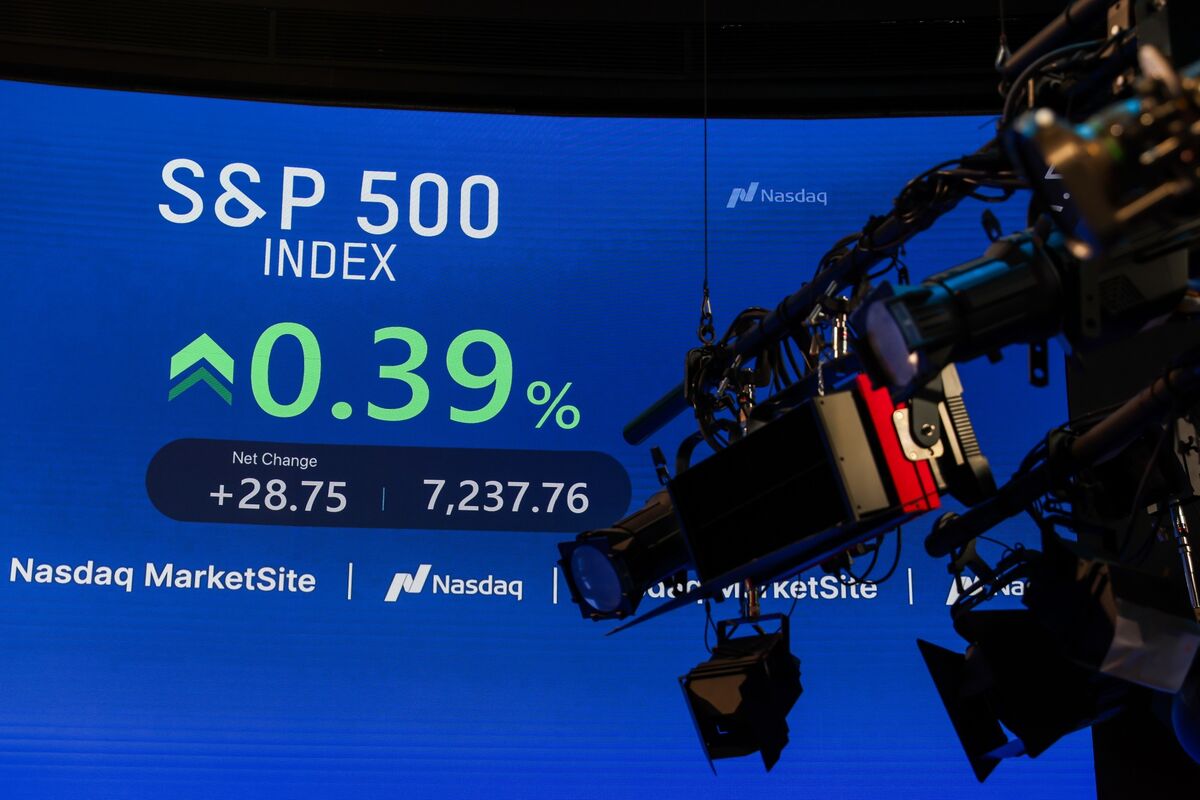
Global investors have been averaging $14 billion of inflows into US equity funds over each of the past 12 weeks, according to EPFR data analyzed by Jefferies. That pace is only about half of the prior peak in December 2024, and roughly one-third on a share-price-adjusted basis, suggesting global allocators may still have room to catch up and support further S&P 500 upside. The article is constructive for US equities but is primarily a flows-driven market commentary rather than a company- or event-specific catalyst.
The key second-order effect is not just incremental demand for US equities, but forced continuation of the “buy the winners” loop. When global allocators are under-owned relative to benchmark and performance momentum keeps widening, they are incentivized to add beta into strength rather than wait for a pullback, which mechanically compresses volatility and extends trend persistence over the next 1-3 months. That is especially supportive for the largest liquidity recipients, where index flows and passive rebalancing can overwhelm fundamental discriminants. This sets up a relative-advantage regime for US large-cap growth, megacap platforms, and high-balance-sheet-quality names that can absorb marginal capital without needing a fresh earnings revision. The losers are typically lower-quality cyclicals and crowded non-US “catch-up” trades: if global managers keep reallocating toward the US, breadth may stay narrow even as index levels grind higher. That creates a fragile but favorable tape — advances driven by flow rather than conviction tend to keep working until positioning becomes fully repaired. The main risk is a flow air pocket: if US macro data disappoints, rates reprice higher, or earnings breadth weakens, underallocated managers may stop chasing and instead wait for a better entry point. That would matter most over days to weeks, not years, because this is a positioning story first and a fundamentals story second. The contrarian view is that the market may already be pricing in this catch-up bid; if inflows are merely normalizing rather than accelerating, upside could be more limited than headline index strength suggests.
AI-powered research, real-time alerts, and portfolio analytics for institutional investors.
Request DemoOverall Sentiment
mildly positive
Sentiment Score
0.20
