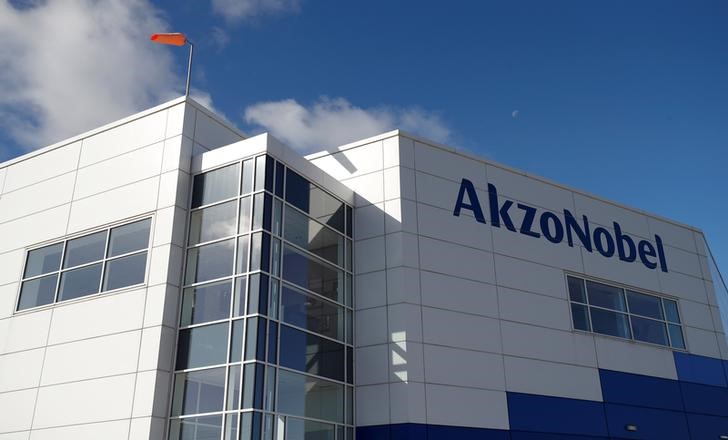
Goldman Sachs downgraded Akzo Nobel to neutral from buy and cut its 12-month price target to €54 from €71 (fundamental valuation to €47 from €61). FY26 adjusted EBITDA was cut 8.4% to €1.33bn (adj. EBITDA margin to 13.4%, -153bps) and EPS FY26 was cut 16.7% to €3.18; revenue FY26 was marginally raised to €9.87bn. Goldman flagged raw-material inflation — its Paints & Coatings Raw Material Basket rose 19% MoM in March — estimating a 20% input-cost shock could imply ~€300m annualised headwind, with ~€150-200m EBITDA impact falling into H2 2026 given Akzo’s ~3-month inventory; Middle East supply risk was also highlighted.
Raw-material volatility is the primary margin lever for coatings companies; empirically, a sustained 10% move in oil- and TiO2-linked inputs translates into a 3–6% swing in EBITDA for vertically light paint majors because of inventory lags and limited immediate pricing elasticity. Firms with global sourcing scale, captive specialty chemistries or aftermarket exposure absorb shocks better — they can redeploy volumes across geographies and compress the pass-through window by 2–3 quarters.
Concentration of sourcing in Asia/EMEA creates asymmetric supply risk: insurance, rerouting and container bottlenecks amplify a feedstock shock into a working-capital shock for distributors and installers, who then destock and amplify volume softness downstream. A short-duration geopolitical spike (days–weeks) will most affect spot feedstock and freight; a multi-month disruption shifts margins and contract negotiations for the next 2–4 quarters.
Key catalysts to watch are feedstock futures curves, distributor days-of-inventory across EU/EMEA, and early signs of price renegotiation in industrial coatings contracts. Reversal can occur within 1–3 months if forward curves collapse and distillate prices normalize, but a persistent sticky up-tick in petrochemicals or TiO2 keeps pressure on margins for 3–12 months. The window for operational responses (mix shift to industrial vs decorative, targeted SKU delisting) is typically 2–6 quarters.
Contrarian angle: market narrative assumes permanent pricing exhaustion; however, differentiated specialty portfolios and M&A optionality create asymmetry. If input prices mean-revert or companies claw back 100–150 bps of margin via SKU rationalization and contract indexing, upside of ~20–30% can materialize within 6–12 months for structurally sound franchises that the market has over-penalized.
AI-powered research, real-time alerts, and portfolio analytics for institutional investors.
Request DemoOverall Sentiment
strongly negative
Sentiment Score
-0.60
Ticker Sentiment
