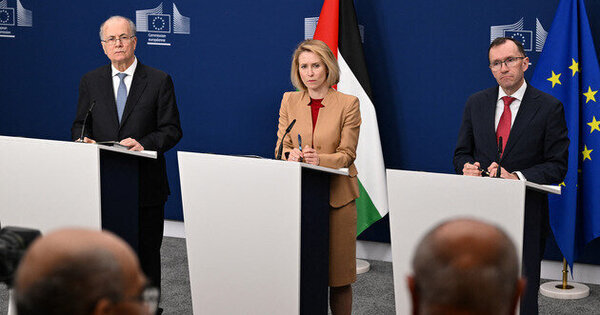
More than 60 countries attended the ninth Brussels session of the International Coalition for the Implementation of the Two-State Solution, as officials pressed for renewed diplomatic momentum on the Israeli-Palestinian conflict. EU and Norwegian officials called for settlement restraint, release of withheld Palestinian tax revenues, and stronger support for the Palestinian Authority, while warning that Gaza’s humanitarian situation remains catastrophic and the West Bank is deteriorating. The article is geopolitically significant but does not indicate an immediate market-moving policy shift.
The marketable signal here is not a peace breakthrough; it is a growing policy floor around the Palestinian Authority and Gaza reconstruction, which shifts near-term capital from pure emergency relief toward quasi-fiscal support and project finance. That tends to benefit regional contractors, engineering, logistics, telecom, and basic materials only if disbursements become programmatic rather than symbolic; otherwise, the bottleneck remains permit risk and security risk, not funding scarcity. The second-order winner is European diplomatic relevance: Brussels is trying to turn an episodic humanitarian response into a standing coordination mechanism, which could keep donor flows elevated for quarters even if the political track stalls. The main loser is the status quo of settlement-linked optionality and any assets whose valuation assumes continued fragmentation and chronic underinvestment in the West Bank/Gaza economy. If withheld tax revenues are partially released, the immediate macro effect is liquidity stabilization for local payrolls and imports, which can compress near-term default risk in Palestinian quasi-sovereign exposures and reduce tail-risk pricing in adjacent EM credit. But because the rhetoric still outpaces enforcement, the base case is a slow drip of support rather than a regime shift; that means the tradeable window is more about sentiment and aid-flow headlines over the next 1-3 months than a durable 12-month rerating. Contrarian takeaway: consensus may be overestimating how quickly reconstruction money translates into real economic activity. In conflict zones, the first 20-30% of pledged capital often goes to administrative overhead, security coordination, and import frictions, while the investable upside arrives only after repeated evidence of corridor access and tax-revenue normalization. The upside catalyst is a credible donor-compliance package; the downside catalyst is renewed violence or another freeze of transfers, which would rapidly re-price the entire reconstruction complex within days. For broader markets, this is a modest de-escalation bias for regional risk premia, not a macro growth catalyst. Expect limited impact on global benchmarks unless the diplomacy starts influencing shipping risk, energy flows, or sovereign credit decisions involving Gulf or EU balance sheets.
AI-powered research, real-time alerts, and portfolio analytics for institutional investors.
Request DemoOverall Sentiment
neutral
Sentiment Score
0.05
