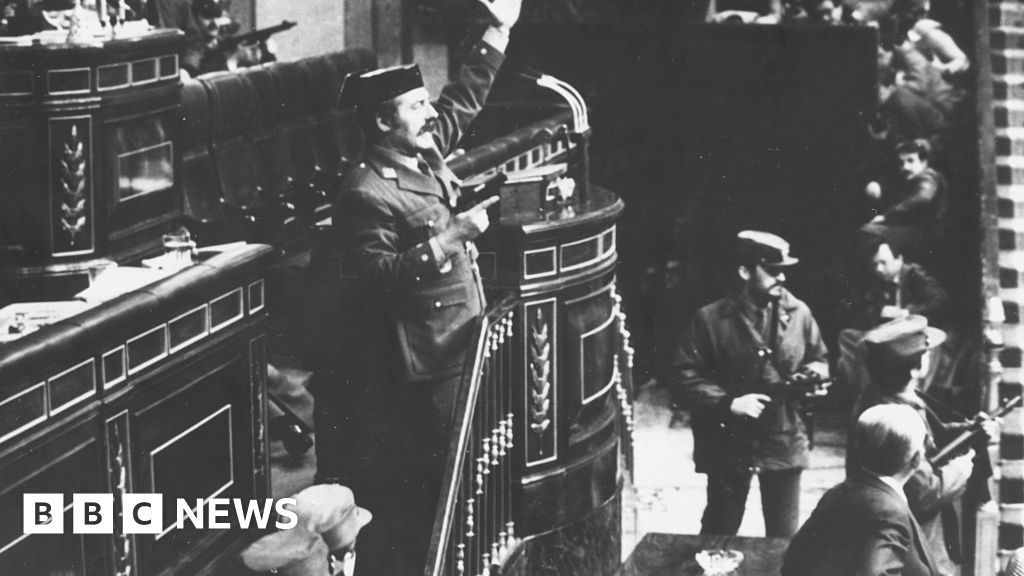
Spain released 153 declassified files on the 23 February 1981 coup attempt as part of a government effort to dispel longstanding conspiracy theories; the release coincided with the death of coup leader Antonio Tejero, 93. Documents include police and judicial reports, transcriptions, foreign reactions and indicate involvement of six intelligence officers and an estimate that a forced police entry could have caused 80–110 deaths, but contain no explosive new revelations; the Socialist government framed the move as correcting a historical anomaly rather than a risk to national security.
Market structure: The declassification is a political-stability event with very low direct economic impact but clear sectoral signals — defense/intelligence contractors (e.g., Indra IDR.MC) and domestic-sensitive banks (SAN, BBVA) are relative winners if perceived sovereignty/stability risk falls. Expect a modest compression of Spain-Germany 10y spread (3–15 bps) and a 0.2–0.6% firmer EUR vs USD/GBP within 1–4 weeks as headline tail-risk is downgraded. Media and litigation-risk exposed families/estates see little market action.
Risk assessment: Tail risk remains asymmetric: a surprise scandal implicating senior figures could widen Spain 10y by 50–150 bps and drop Spanish equities 10–25% in days; probability low (<5%) but should cap leverage. Timeframes: immediate (days) = small volatility spikes; short-term (weeks–months) = modest peripheral spread tightening; long-term (quarters–years) = possible reallocation to cybersecurity/defense procurement (+5–15% revenue opportunity for contractors). Hidden dependency: any intelligence reform can delay procurement for 6–18 months.
Trade implications: Tactical plays favor small, opportunistic long exposure to Spanish cyclicals and defense and a peripheral bond carry tilt: e.g., 1–2% portfolio long IDR.MC and 1–3% long EWP (Spain ETF) for 3–6 months; hedge with a 3–6 month 20–30 bps widening stop. Use Spain 10y vs Bund short spread (target 5–15 bps squeeze) via futures with PV01 limits; consider 3-month EUR long vs USD forward (size 0.5–1% portfolio) anticipating mild EUR strength.
Contrarian angles: Consensus understates policy follow-through: if declassification leads to institutional reviews, expect incremental budget shifts into cyber/intel services — not headline defense platforms — lifting vendors like Indra by 5–15% revenue over 12–24 months. Market reaction is likely underdone (no immediate move), so small, staged entries with tight stops exploit low-volatility entry; conversely, don’t overpay for peripheral sovereign risk compression — cap positions and use options to define downside.
AI-powered research, real-time alerts, and portfolio analytics for institutional investors.
Request DemoOverall Sentiment
neutral
Sentiment Score
0.00
