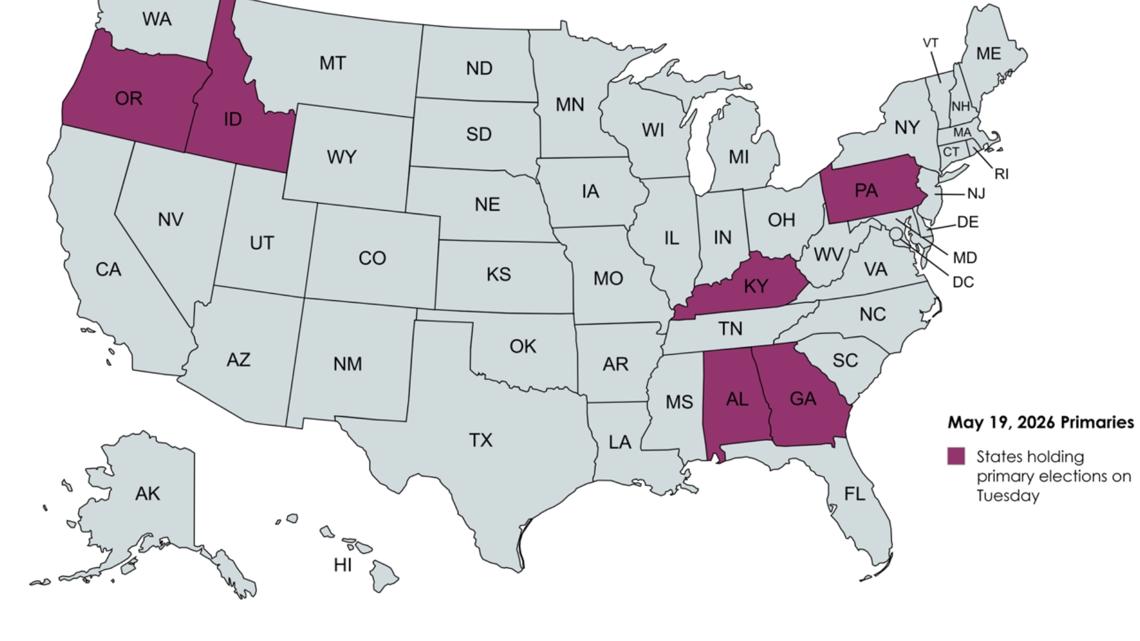
The article previews Tuesday primary elections in six states, highlighting key contests in Alabama, Georgia, Idaho, Kentucky, Oregon and Pennsylvania. It focuses on candidate lineups, Trump and Biden endorsements, runoff rules and polling times, with no direct market-moving policy or economic developments. The piece is informational and politically focused, implying minimal immediate market impact.
The immediate market read is not about who wins tonight; it’s about whether the results validate the current model of intra-party sorting in the South and exurbs. If Trump-backed candidates overperform in Alabama/Kentucky/Georgia, it strengthens the thesis that endorsement alpha is still real in low-turnout primaries, which can matter for downstream policy positioning even before the general election. The bigger second-order effect is candidate quality: when primaries reward loyalty over electability, it increases the probability of more polarized general-election nominees, which tends to widen expected legislative gridlock and lowers the odds of any business-unfriendly surprise consensus.
The more interesting state-level implication is on local political capital, not federal control. Georgia and Pennsylvania are the swing-state tells: if moderate or crossover-friendly candidates lose in primaries, it suggests 2026 general-election messaging will skew more combative, raising the odds of split-ticket fatigue and lower enthusiasm in suburban donor bases. That can matter for bank, utility, and regulated-infrastructure narratives because the market typically prices policy continuity too early; a stronger polarization signal argues for keeping duration and rate-sensitive equities paired against sectors that benefit from stalemate rather than reform.
Contrarian view: the market may overstate the importance of Trump endorsement wins as a clean read on November outcomes. Closed/open primary rules and low-turnout electorates mean these contests are a noisy subset of the general electorate, so a “mandate” interpretation would be overstretched. The better trade is to treat this as a volatility event for political risk premia, not a directional macro catalyst; if the more mainstream candidates survive in Pennsylvania and Georgia, that likely compresses implied policy uncertainty faster than headline punditry suggests.
AI-powered research, real-time alerts, and portfolio analytics for institutional investors.
Request DemoOverall Sentiment
neutral
Sentiment Score
0.00
