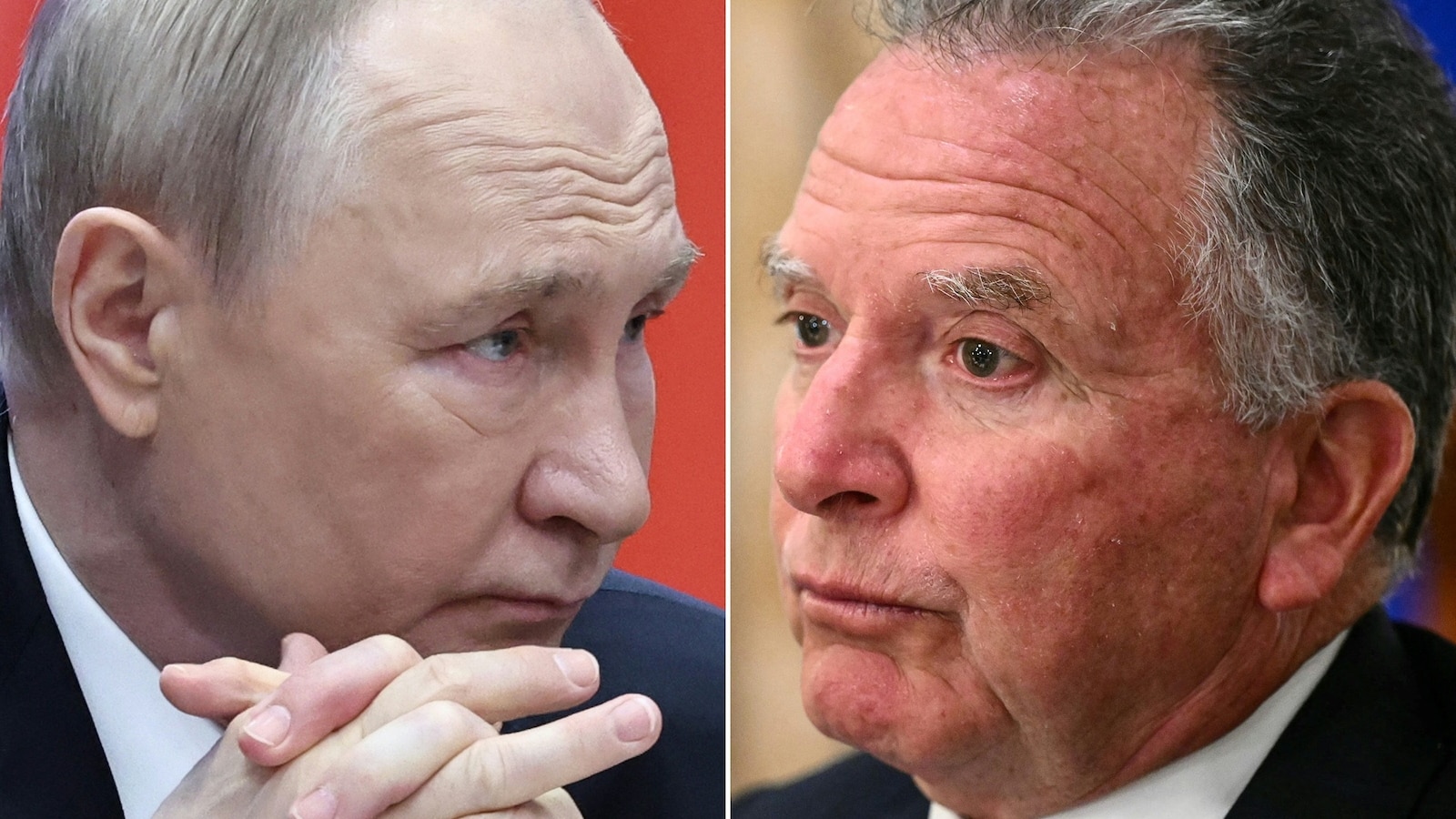
Special envoy Steve Witkoff, accompanied by Jared Kushner and other senior U.S. officials, is meeting Vladimir Putin in Moscow after weekend talks with a Ukrainian delegation in Florida aimed at refining a revised 19-point peace plan to end the Russia-Ukraine war. Kyiv reports progress but warns key issues — including potential territorial concessions — remain unresolved, while Kremlin rhetoric and Putin’s prior hardline statements make a breakthrough uncertain. The meeting, the sixth Witkoff-Putin sit-down this year, is being watched for any sign of concrete concessions or de-escalation that could materially alter geopolitical risk premia, though markets should treat near-term odds of a decisive agreement as low.
Market structure: A low-probability/low-confidence diplomatic path keeps a two-way market: winners if talks fail are defense contractors (LMT, RTX) and energy/commodity producers (XOM, CVX, broad commodity complex) due to continued supply risk; winners if unexpectedly successful are cyclicals, European exporters, and Russian-adjacent reconstruction plays. Expect defense order backlog pricing power to persist near-term; oil/gas risk premium remains asymmetric (+5-15% shock possible within 30-90 days if talks collapse). Cross-asset: escalation -> safe-haven bid (gold +5-8%, UST 10y -20 to -50 bps), de-escalation -> risk-on (equities +3-7%, 10y +10-30 bps), FX moves concentrated in RUB (volatile ±10% intramonth) and EUR/GBP vs USD.
Risk assessment: Tail risks include a rapid binding peace (15-30% downside to defense names in 5 trading days), a Russian escalation or false-flag operation (material commodity shocks), or unilateral sanctions shifts tied to U.S. domestic politics. Time horizons: immediate (48-72 hours) expect headline-driven 3-8% moves; short-term (weeks) driven by negotiation leaks and battlefield shifts; long-term (quarters) driven by reconstruction spending and NATO/EU defense budgets. Hidden dependencies: U.S. domestic politics (Trump/Kushner involvement) can rapidly change sanction regimes; European winter gas inventories are a binary catalyst.
Trade implications: Implement asymmetric/hedged positions: favor 2-4% overweight in US defense and energy equities while buying tail protection (puts) and holding 1-2% in gold. Use FX/commodity exposure rather than direct Russian equities; prefer XLE, GLD, LMT/RTX plus protective option structures. Entry: stage buys over 48 hours around confirmed meeting outcomes; exit/trim on a confirmed ceasefire within 30 days or a >15% rally in defense names.
AI-powered research, real-time alerts, and portfolio analytics for institutional investors.
Request DemoOverall Sentiment
neutral
Sentiment Score
0.00
Contrarian angles: Consensus underestimates protracted stalemate leading to persistent elevated energy/commodity prices and sustained defense capex — markets may underprice reconstruction-related trades (construction materials, engineers) which could outperform if a negotiated pause becomes a multiyear rebuild. The market may also under-react to a deal: even a limited ceasefire could quickly rerate cyclical sectors by >5-10% while leaving defense valuations too rich, creating shorting opportunities. Historical parallels (post-1990s ceasefires) show short-lived rallies then prolonged reconstruction-driven flows; plan for both phases.
