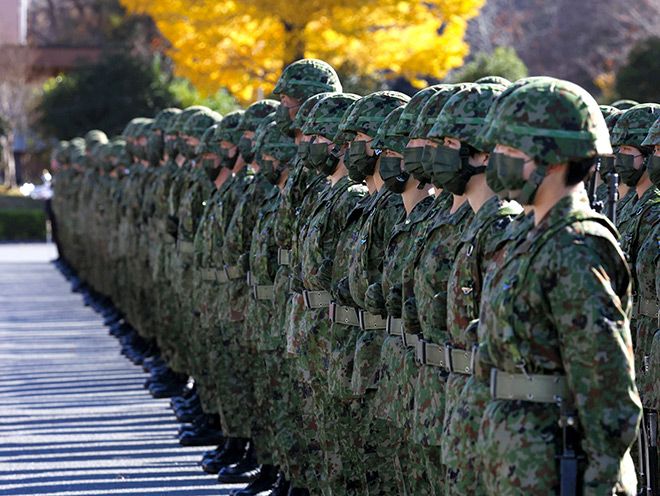
A Cabinet Office national survey shows a record 82.6% of Japanese adults expressed interest in the Self-Defense Forces (up 4.4 percentage points from 2022), with 53.7% citing SDF disaster response as the primary reason. A combined 68.3% favor or somewhat favor expanding defense equipment exports beyond the current five-category restriction, while 68.1% and 65.3% respectively cited concern about China’s military modernization and North Korea’s nuclear/missile programs; questionnaires were mailed to 3,000 adults with 1,534 responses. The results bolster political momentum for loosening export limits and underscore public support for defense-related policy shifts that could affect domestic defense contractors and government procurement decisions.
Market structure: Polls showing 68%+ public support for expanded defense exports and 82.6% interest in the SDF commoditize political cover for higher procurement and relaxed export rules. Direct winners are large Japanese defense primes and their supply chains (MHI 7011.T, Kawasaki 7012.T, Mitsubishi Electric 6503.T, NEC 6701.T, IHI 7013.T) which can capture 10–30% incremental backlog over 12–36 months; steel/copper producers (e.g., Nippon Steel 5401.T) could see inputs demand lift 3–8% and supplier pricing power rise 200–400 bps in gross margins.
Risk assessment: Tail risks include legislative deadlock (no policy change within 6–12 months), regional escalation triggering sanctions or supply-chain breakdowns, or cost-overruns compressing margins by >10% on big programs. Near-term (days–weeks) volatility will hinge on budget language in Feb–Mar 2026; medium-term (3–12 months) depends on Diet approval and initial export contracts; long-term (1–3 years) on execution, industrial capacity and US-Japan interoperability agreements.
Trade implications: Actively favour concentrated, event-driven exposure to large primes and a rates/FX hedge: long selective equities (7011/7012/6503) with 12–24 month horizons, funded by tactical rates steepener (short 10y JGB futures / long 2y JGB futures DV01-neutral) and a small long USD/JPY call. Use capped option structures (vertical call spreads or LEAPS) to limit downside while capturing a 20–35% upside if export policy is liberalized and FY2026 budget adds >¥1.5–2.0 trillion.
Contrarian angles: The consensus underestimates execution friction — procurement cycles, offensive limits tied to US tech transfers, and export licensing delays can push revenues >12 months out and cap near-term multiple expansion. If the Diet dilutes export scope (only partial liberalization), stocks may re-rate down 10–20% from current levels; stage entry around concrete budget/procurement announcements to avoid paying for headline-driven optimism.
AI-powered research, real-time alerts, and portfolio analytics for institutional investors.
Request DemoOverall Sentiment
neutral
Sentiment Score
0.10
